Yes — hail is a covered peril under standard HO-3 homeowners policies. The complications aren't whether it's covered; they're how much you'll actually receive after the percentage deductible, cosmetic exclusion, and matching-coverage limits do their work. On a $400,000 home in a hail market, the difference between "covered" and "covered enough to replace the roof" is often $5,000-15,000.
What's covered
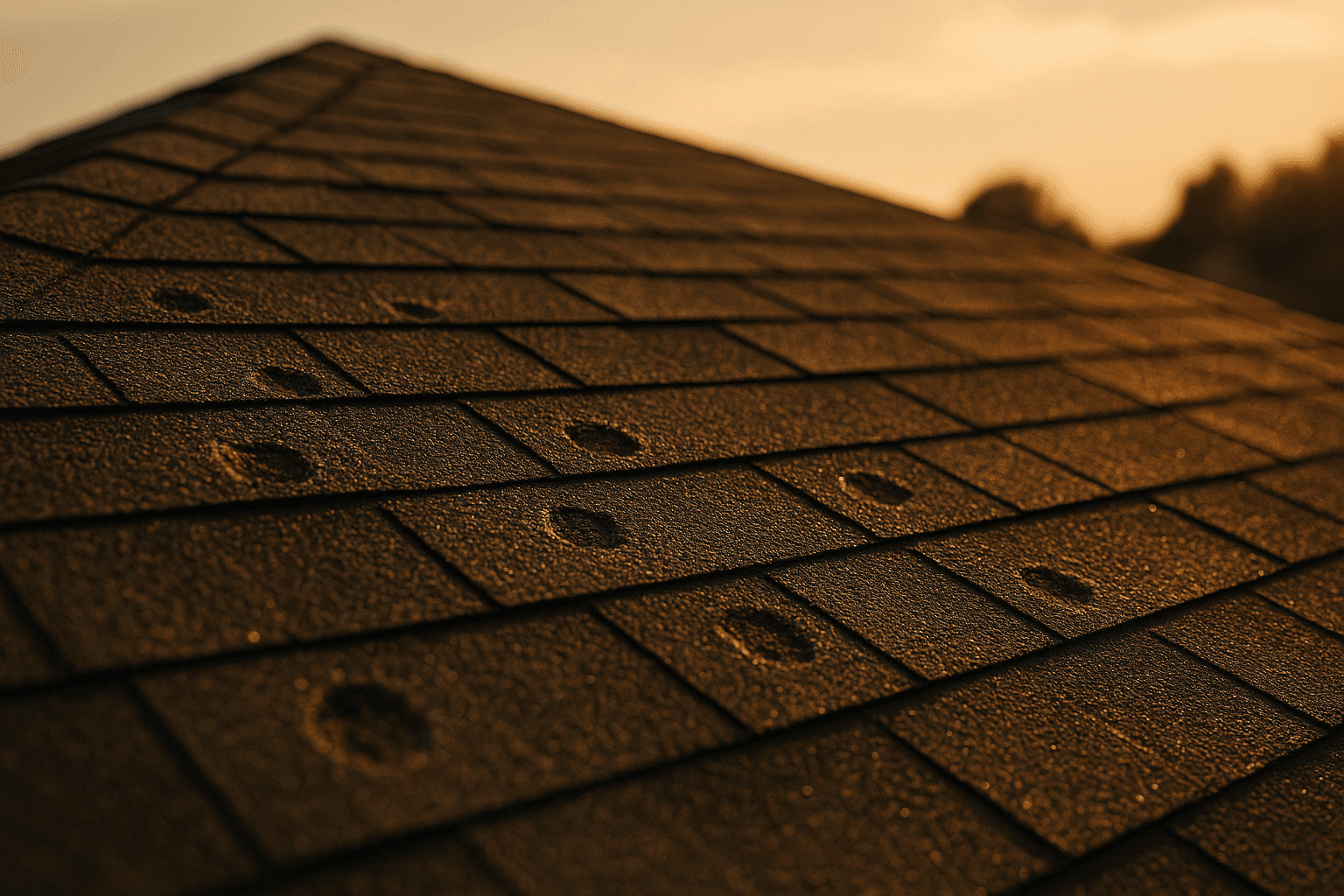
Functional damage is covered: fractured shingles, exposed mat where granules have been knocked off, hail bruising that compromises the asphalt's UV protection layer, dented metal panels that affect water shedding. The standard test is whether the damage reduces the roof's ability to do its job — shed water and protect the deck — or shortens its remaining service life.
Cosmetic damage is increasingly excluded specifically on metal roofs, where dents may be visible but don't affect performance. This is the most common modern exclusion in hail markets and gets added through a "Cosmetic Damage Exclusion" endorsement at renewal — often without homeowner notice. If you have a metal roof in Colorado, Texas, Oklahoma, Kansas, Nebraska, or Missouri, read your endorsements specifically for cosmetic-damage language.
The wind/hail percentage deductible — the biggest surprise
This is the trap that catches the most homeowners. Instead of your flat $1,000-2,500 deductible, the wind and hail peril uses 1-5% of dwelling coverage. The math:
- $400,000 dwelling × 1% = $4,000 wind/hail deductible
- $400,000 dwelling × 2% = $8,000 wind/hail deductible
- $400,000 dwelling × 5% = $20,000 wind/hail deductible (rare, hurricane-belt only)
This is actually the deductible that applies to a hail claim — not the $1,000 printed on the front of your policy. Standard in Colorado, Texas, Oklahoma, Kansas, Nebraska, Missouri, Florida, and Louisiana. Read the declarations page under "perils" or "coverage A wind/hail" before you assume what your out-of-pocket will be. The Colorado state page and Kansas state page both flag this for their hail-market readers.
A claim that looked like a $3,000 net win against a $1,000 deductible is actually a $5,000 loss against a 2% wind/hail percentage deductible. Run the math before you call your agent.
The matching coverage debate
When hail damages 2 of 4 slopes, do you replace just those 2 or the whole roof? The standard adjuster scope is to replace only damaged slopes. The standard contractor estimate is to replace the whole roof for color and weathering match. The gap is real, and the resolution depends on your state and policy.
Some states — California, Illinois, Kentucky, and a handful of others — have "matching laws" or "uniformity statutes" requiring carriers to pay for aesthetic continuity when partial replacement creates an obvious mismatch. Most states don't. Many policies include a "matching of undamaged property" limit at $5,000-10,000 that caps the carrier's exposure on aesthetic continuity claims.
The supplement battle is winnable with the right documentation. Photos showing the discontinuity at slope edges, contractor letterhead documenting the impossibility of color-matching after 8+ years of weathering, manufacturer batch-availability letters — these turn the supplement from a request into a defensible position. See the storms and insurance hub for the supplement playbook.
Class 4 impact-resistant shingles — the only mitigation that pays you back
UL 2218 Class 4 impact-rated shingles are the only roof material change that triggers premium discounts in hail markets. The discount typically runs 10-30% on the wind/hail peril, depending on carrier and state. Standard in Colorado, Kansas, Nebraska, Missouri, Oklahoma, Texas.
The math, on a $2,400/year policy with $400 attributable to wind/hail peril: a 25% discount = $100/year savings. The Class 4 material premium over standard architectural is typically $1,500-3,000 on a 2,000 sqft replacement. Payback: 15-30 years on premium alone — but the calculation underweights the more important factor, which is reduced claim severity. A Class 4 shingle that survives a hailstorm with no claim filed avoids both the deductible and the 3-5 year premium hike. That's the real payback.
This is reference, not a quote. The discount alone usually doesn't justify the upgrade. The combination of discount plus claim avoidance does, in extreme-hail markets like Colorado's Front Range and Kansas/Nebraska/Missouri's storm corridor.
See the materials hub for the full Class 4 shingle comparison — manufacturer, warranty terms, and where the upgrade pencils versus where it doesn't.
How carriers verify the storm
Adjusters cross-reference NOAA Storm Events Database for the date and zip code. The database logs hail events from spotter reports, radar-confirmed signatures, and ground-truth verification. A claim filed for a date with no NOAA-documented event in your area is denied or downgraded — the carrier's first move is to pull the NOAA record.
Pull it yourself before filing. The NOAA Storm Events search is free and gives you the same data the adjuster will see. Confirms (or contradicts) the storm-chasing contractor pitch about "the big hail event last week" that may or may not have actually crossed your address.