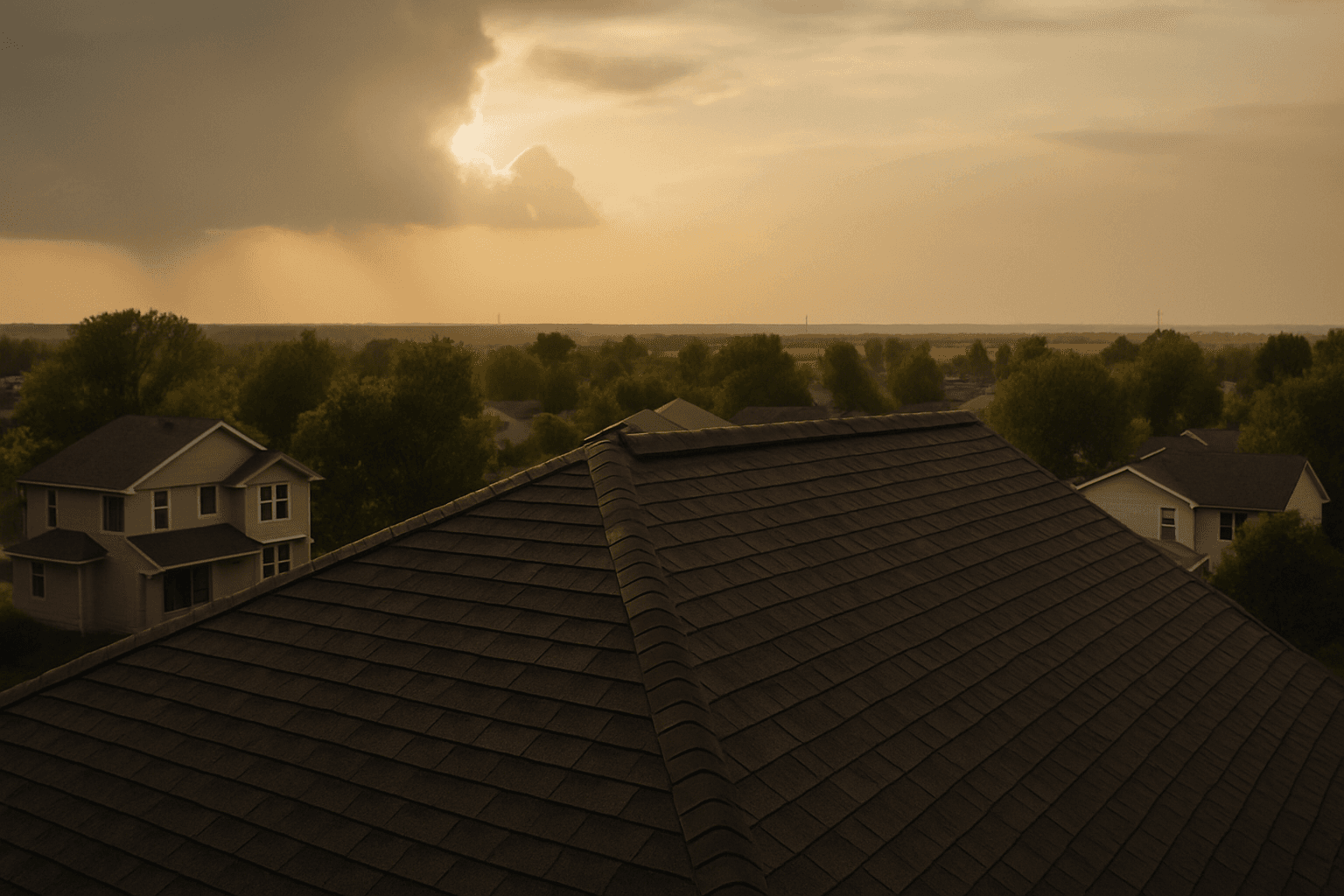
Oklahoma sits at the seam between the Plains and the Southeast, and on the hail map it sits squarely inside the worst belt the country produces. The state's zone 3A climate combines extreme hail frequency with severe straight-line winds and one of the highest tornado densities in the country — and that exposure is why Class 4 impact-resistant asphalt shingles already account for roughly 62% of the local roofing market, the single highest share of any state we track. Replacement costs for a 2,000 sqft asphalt roof run $9,000–$17,500 (2026 estimate), with a median near $12,000. Oklahoma licenses roofing contractors at the state level through the Construction Industries Board.
The dominant failure mode in Oklahoma is rarely age. It is a single hail event — sometimes two or three in a single season across the OKC and Tulsa metros. A 1.5" hail strike will functionally end the service life of a standard architectural shingle even when it still looks intact from the ground, because granule loss exposes the asphalt mat to UV and runs out the warranty across the next two summers. This is why most Oklahoma carriers now write hail almost as a separate product, and why the Class 4 premium pays back faster here than the sticker price suggests.
The percentage-deductible trap
Wind/hail percentage deductibles are now standard on most Oklahoma residential policies — typically 1-3% of dwelling coverage. On a $350,000 home, that means $3,500–$10,500 out-of-pocket before the carrier pays the first dollar, and that math happens before any depreciation hit on an actual cash value (ACV) roof endorsement. Read the declarations page. If the policy lists ACV on roof, the carrier pays depreciated value rather than replacement cost — and on a 12-year-old roof, the depreciation gap alone can exceed the deductible.
The other Oklahoma trap is storm-chaser activity. After a major hail event anywhere from El Reno to Broken Arrow, out-of-state contractors arrive within days, sign homeowners to assignment-of-benefits agreements, and disappear once the carrier closes the claim. Verify the license at the Construction Industries Board, confirm the contractor's physical Oklahoma address has been operating for at least three years, and never accept an offer to "absorb" or "waive" the deductible. That offer is illegal under state insurance fraud statutes regardless of how it is framed.
Solar in Oklahoma after the federal credit expired
The federal residential solar Investment Tax Credit ended December 31, 2025. Oklahoma has no surviving state-level solar incentives — no SRECs, no state tax credit, no statewide rebate. Net metering varies by utility, and OG&E and PSO have both moved newer residential customers onto two-channel billing that credits exports at avoided-cost rather than full-retail rates. The honest 2026 answer is that solar payback now runs entirely on the spread between retail rates and the export credit, and the math has materially weakened without the federal credit. This is reference, not a quote — your specific replacement cost and payback depend on pitch, layers, decking condition, utility territory, and orientation.