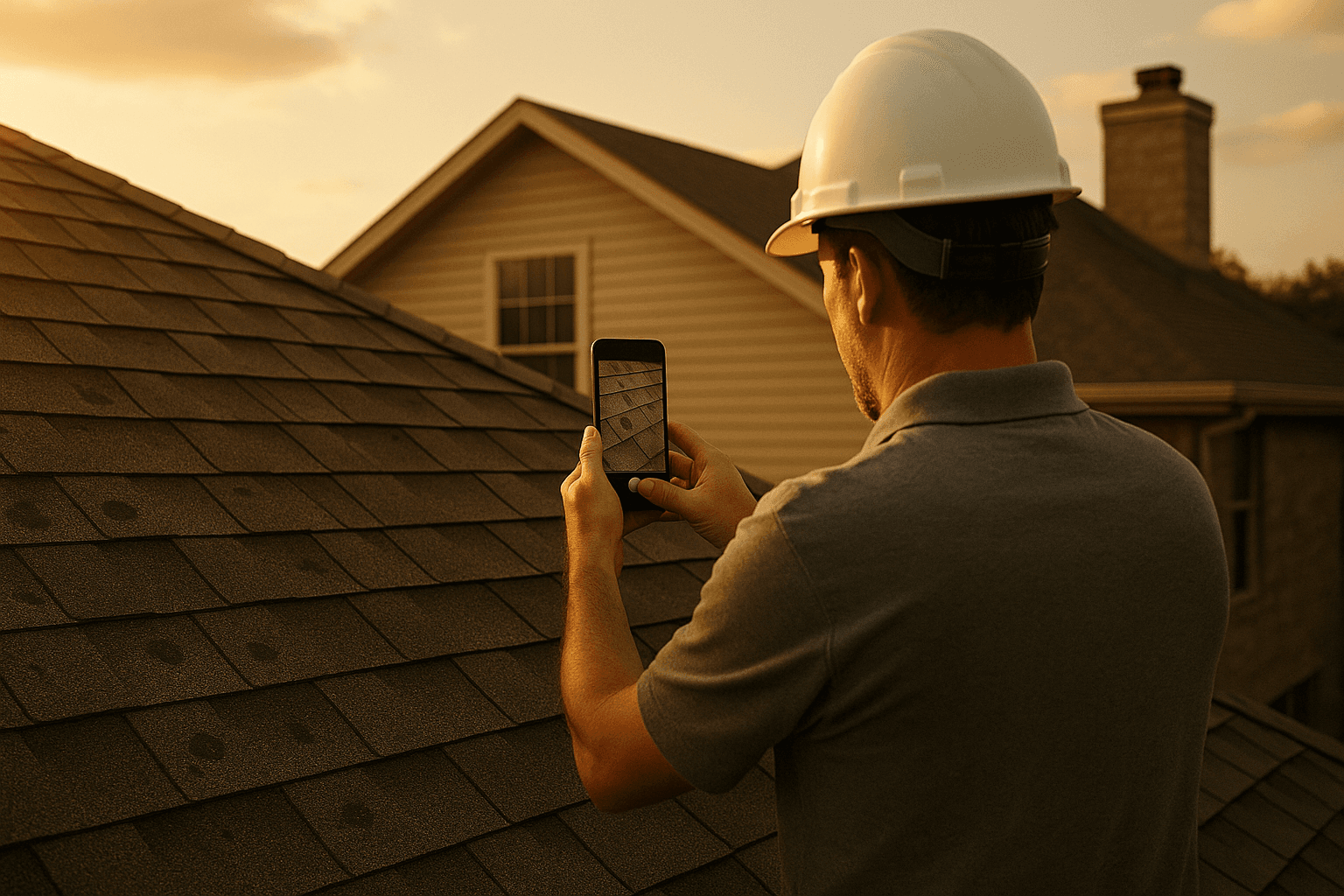
Drone or ladder photos within 72 hours, date-stamped. The NOAA Storm Events report for your date and zip. An independent inspector's report — not from the contractor bidding the repair. Photos of every slope, every penetration, and the deck if accessible. Keep originals; submit copies. Documentation is the single biggest variable in claim outcomes.
The 72-hour window
Two reasons this matters. First, post-storm weather degrades evidence over the following weeks. Rain washes out the freshly-bruised pattern on asphalt, granule displacement gets blown into gutters and lost, hail dimples on metal continue to round out as thermal cycling expands and contracts the panel. The damage you photograph in week 4 isn't the same damage that existed in hour 24.
Second, carriers' default position on late documentation is that the damage is unrelated to the claimed event. A photo timestamped 14 days after a NOAA-confirmed storm is already a worse photo than one timestamped 14 hours after — even if the underlying damage is identical. The adjuster's job includes asking "is this damage from the storm we're discussing, or from accumulated weathering?" Contemporaneous documentation removes that question.
If 72 hours has passed before you're reading this, document anyway, in the next 24 hours. Late documentation is weaker than early documentation but stronger than no documentation.
What to photograph — the discipline
Every slope, every penetration, every line of attack the storm took. The full sequence:
- Each roof slope at multiple angles. Wide shot showing the full slope, then mid-range showing concentrations of damage, then close-ups (within 6 feet) of representative shingles. Repeat for north, south, east, west.
- Every penetration. Vents, pipe boots, chimney flashing, ridge vents, satellite-dish mounts, solar standoffs. These are where leaks start; adjusters know to look here.
- Soffits and fascia. Hail damage often shows on the underside trim before it shows on the roof itself. Granule accumulation in gutters is corroborating evidence.
- The deck if accessible. Through an attic hatch, look for daylight through the deck, water staining on the underside, deflection of the sheathing. Take photos.
- Surrounding context. Neighbor's roof if visible, ground-level damage (downed limbs, dented HVAC fins, broken pavers), the storm-track line if there's a directional pattern.
Phones preserve EXIF metadata — date, time, GPS coordinates — which is the carrier's standard verification of contemporaneity. Don't strip the metadata when sending. Carriers occasionally challenge stripped photos as suspect.
Pull the NOAA report yourself
The NOAA Storm Events Database is the carrier's first stop on causation verification. It logs hail events from spotter reports, radar-confirmed signatures, and ground-truth verification, indexed by zip code and date.
Pull the report for your date and zip before filing. If a hail event is documented for your address area on the date in question, your claim has independent third-party corroboration. If it's not, you need to either find adjacent zip codes with documented events (showing the storm track passed near you) or reconsider whether a claim makes sense. A claim filed for a date with no NOAA-documented hail in your area is denied or downgraded as a matter of routine.
The report is free, takes 5 minutes, and gives you the same data the adjuster will see.
Why the inspector should be independent
The contractor bidding your replacement has a financial incentive to find more damage than may actually exist. Adjusters know this. A contractor's damage report — especially from a storm-chasing roofer — gets discounted on first review, sometimes by 20-40% on the scope.
An independent inspector — someone you pay $200-400 for the inspection alone, with no involvement in the repair — produces a more credible report. The inspector has no skin in whether the claim becomes a $4,000 supplement or a $14,000 full replacement. Their incentive is the report fee and the reputation; the carrier reads the report differently as a result.
This is reference, not a quote. The asymmetry between contractor and inspector incentive structures is the single biggest documentation lever you have. Use the find-a-roofer directory to locate inspectors who explicitly do not bid replacement work.
The AOB trap
Assignment of Benefits is a one-page document the contractor presents during the post-storm canvass: "sign here so we can deal with your insurance directly." The trap mechanic: you sign over your right to claim payment, the contractor files and negotiates the claim, the carrier pays the AOB-holder directly. When the carrier pays $4,000 on a contractor's $14,000 invoice, you're contractually on the hook for the $10,000 difference — the AOB-holder's lien attaches to your property if you don't pay.
Florida (SB 76, 2021) and Texas (542A reforms) restricted AOBs after the 2017-2022 storm-chase litigation wave. Other hail-market states are following. If a contractor presents an AOB on the day of canvass, that's a signal to slow the conversation down, not speed it up. File the claim in your own name; pay the contractor on completion.
Receipts and chain-of-custody
Keep paper or digital copies of:
- Tarp purchase, board-up materials, mitigation costs (reimbursable under "duty to mitigate")
- Inspector report and invoice
- Hotel/lodging if the home is uninhabitable (Coverage D, Loss of Use)
- Any contractor's damage report on letterhead
Submit copies to the carrier; keep originals. If the claim becomes contested, the original chain-of-custody is what defends the documentation. See the insurance claim tool for the full file-checklist sized to your specific claim.