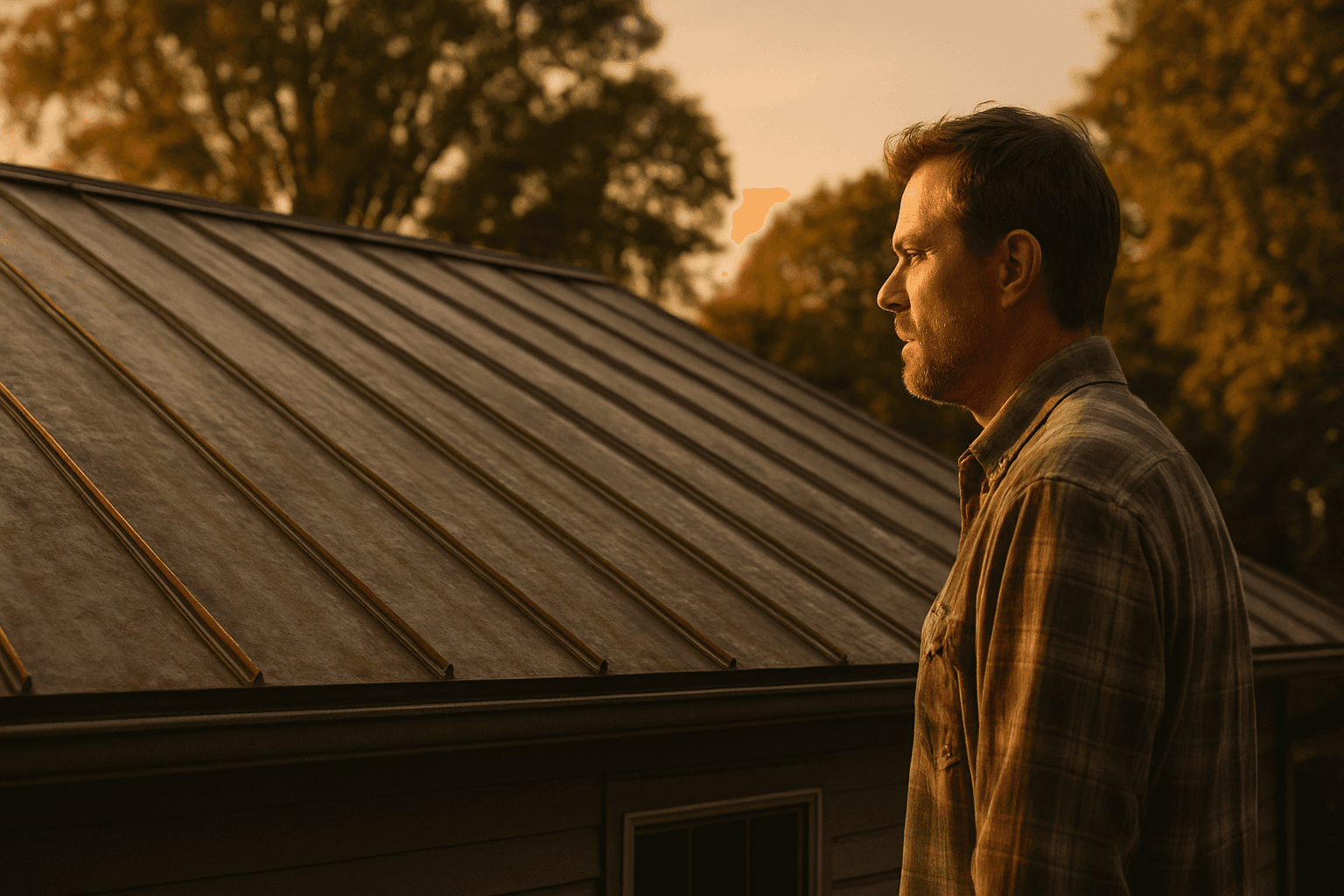
A standing-seam metal roof on a residential home — installed at 24-gauge steel or aluminum, finished with a PVDF/Kynar 500 coating, and properly flashed at penetrations — should last 40-60 years. Premium copper installs run 60-100+ years; some surviving copper roofs in Europe pass the 200-year mark. At the lower end, corrugated exposed-fastener panels on a residential roof typically reach 25-30 years before gasket failure forces replacement. The range across "metal roof" as a category is wide.
That spread isn't random. Three variables decide where a specific install lands: the metal type and gauge, the panel system, and the coating spec.
Lifespan by metal type and panel system
Standing-seam steel (24-gauge): 40-60 years. The residential workhorse. Steel coated with Galvalume or galvanized substrate plus a Kynar 500 topcoat resists corrosion, holds color, and survives most hail. The seams interlock mechanically with concealed clips — no fasteners penetrate the panel face.
Standing-seam aluminum (24-gauge): 40-60 years. Similar lifespan to steel on the panel itself, with the corrosion advantage in coastal/salt-air markets. The trade-off is hail denting — aluminum is softer and shows more cosmetic damage in 1.5-inch+ hail. Functional lifespan is comparable to steel in most climates.
Stone-coated steel: 30-40 years. Steel substrate with a stone-granule coating that mimics architectural shingle aesthetics. Lifespan trails plain standing-seam because the stone coating eventually loses adhesion and the underlying coating gets exposed. Often spec'd in HOA-restricted neighborhoods that won't approve a metal-finish look.
Corrugated exposed-fastener panels (26-29 gauge): 25-30 years on residential. The barn-grade product. Panels have visible screws through the face into the substrate, with neoprene or EPDM gaskets under each screw. Gasket failure is the limiting factor — gaskets stiffen and crack from UV/thermal cycling, screws back out, water enters through the fastener pattern. Panels themselves remain structurally intact long after the assembly leaks.
Copper (16-20 oz): 60-100+ years. The heritage product. Develops a green-blue patina over decades that's the desired aesthetic. Cost runs 4-6× standing-seam steel, which puts copper in custom/historic-preservation territory rather than mainstream residential.
Why exposed-fastener systems fail at the gaskets
The gasket-failure mode is actually the most common metal-roof complaint, and it's a different failure than people expect. The metal panels look fine. The roof leaks anyway. Replace the panels and the new install does the same thing in 20 years because the design — fasteners through the face, gaskets sealing them — has a finite life regardless of what's installed above. This is why standing-seam isn't a luxury upgrade; it's the engineering choice that removes the failure mode.
If a proposal lists "metal roof" without specifying standing-seam versus through-fastened, it's most often through-fastened. Ask the question. The cost difference is significant — through-fastened runs about 1.6-1.8× the asphalt baseline, standing-seam runs 2.4× — and the lifespan difference is even larger.
Coating spec — the appearance-lifespan driver
The coating decides how long the roof looks good, separate from how long it performs. PVDF resin coatings — sold as Kynar 500 or Hylar 5000 — hold color and gloss 40-50 years with minimal fade. SMP (silicone-modified polyester) is the middle tier — good for 25-30 years with visible fade by year 15. Plain polyester fades and chalks within 8-12 years and shouldn't be on a residential proposal.
A 50-year structural lifespan with a 15-year coating means the roof fails on appearance long before it fails on function. Match the coating to the intended ownership horizon. PVDF is the residential standard for any roof intended to last past year 25.
What makes a metal roof prematurely fail
In order of frequency: cheap coating systems (polyester chalking by year 10), exposed-fastener panel selection on residential roofs, under-gauge panels (29-gauge sold as residential when it isn't), sealant-only flashing at penetrations rather than mechanically-flashed boots, and tree-limb impact on softer alloys. Most premature failures trace to install spec choices, not the metal itself failing.
The 24-gauge / standing-seam / Kynar 500 spec is the conservative residential baseline. Anything below that is a budget compromise — sometimes appropriate, but worth identifying explicitly on the proposal so the lifespan expectation matches the install.
For the full materials decision tree see materials. For lifespan-by-material across all roof types — including how warranty math compares to field-observed lifespan — see lifespan. For the full replacement-cost picture see replacement.
This is reference, not a quote.