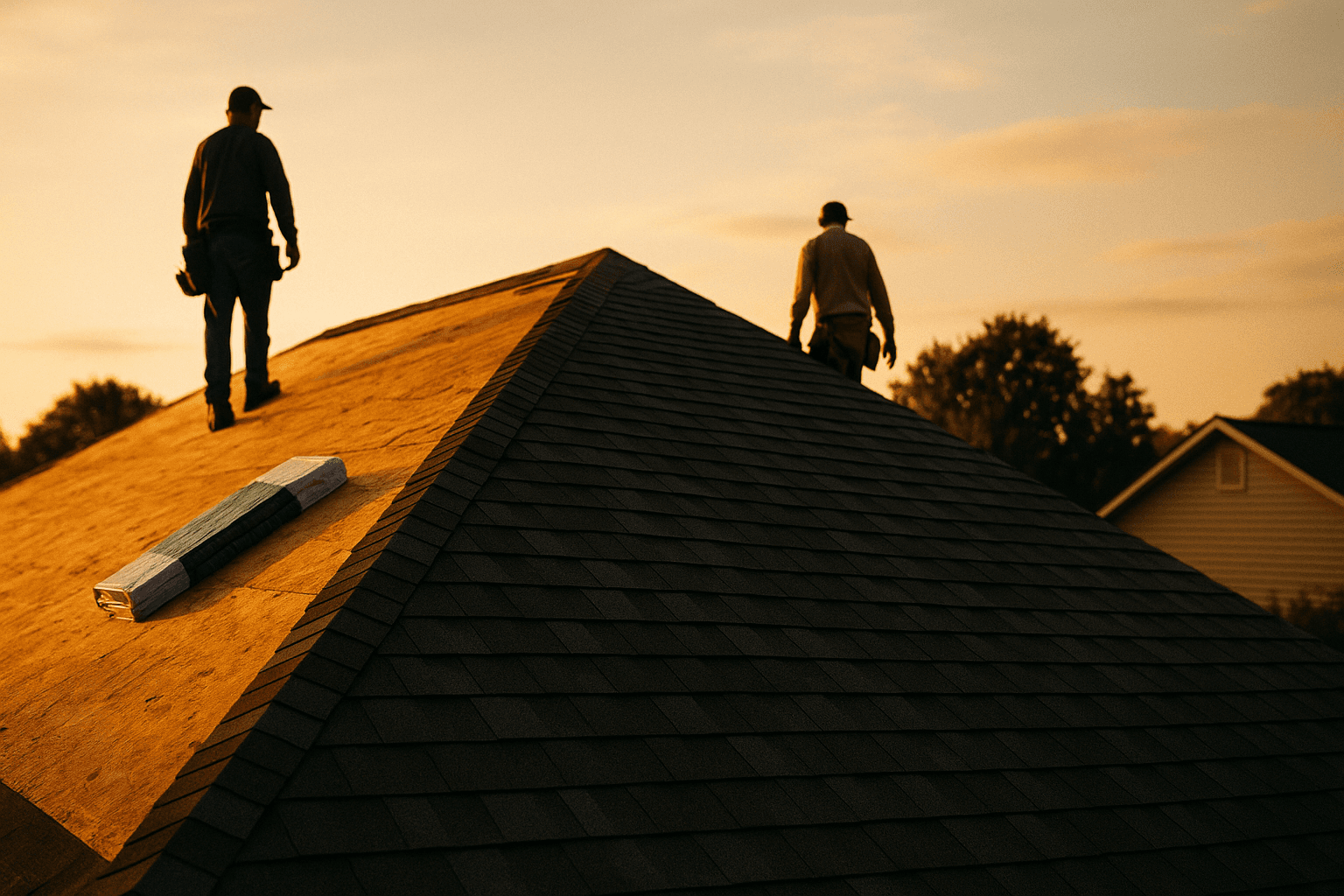
Most homeowners hear "1-2 days" from the first roofer they call and assume that's the whole story. It's the floor, not the ceiling. A simple 2,000 sqft single-story asphalt replacement actually lands in that window when conditions cooperate. Steep pitches, multiple stories, tile or slate materials, and any meaningful weather contingency push the timeline to 3-5 days or longer. Here's the sequence and the variables that move it.
The standard sequence
Every replacement runs through the same six stages, regardless of material. Tear-off strips the existing layers down to the deck and stages debris into a dump trailer. Deck inspection walks every sheet for rot, soft spots, and fastener pull-through. Underlayment lays ice-and-water shield at eaves, valleys, and around penetrations, then synthetic underlayment across the full deck. Flashing installs or reseals at chimneys, sidewalls, valleys, vents, and skylights. Field installation runs from the eaves up — starter strip, then field shingles or panels — capping at the ridge. Cleanup runs a magnetic sweep across landscaping and driveway for nails, removes the dump trailer, and walks the homeowner through the finished roof.
Crew size dictates pace as much as the sequence does. A 4-6 person crew runs a 2,000 sqft asphalt cleanly in 1-2 days. A 2-3 person crew on the same roof runs 3-4 days. Larger isn't always better — a 10-person crew on a small roof is just paying for redundant labor — but undersizing the crew is the main reason simple roofs run long.
Weather is the wildcard
Asphalt shingles use heat-activated seal strips that bond when deck temperatures exceed roughly 40°F. Below that, the strips don't activate properly and the roof remains vulnerable to wind uplift until the next warm stretch — sometimes weeks later. Winter installs in northern states (CT, MA, NY, MN, WI, ME) frequently push into spring for this reason. Standing-seam metal and tile have lower temperature constraints but still require dry, calm conditions.
Active rain stops every anchor-fastened roof. The deck can't get wet during install — wet OSB swells, wet plywood delaminates, and any moisture trapped under new underlayment becomes a long-term mold and rot problem. A reputable crew will tarp and pause rather than push through a forecast.
Sustained winds above 25 mph make working a steep pitch unsafe and slow even moderate pitches. This isn't a homeowner-visible delay so much as a why-isn't-anything-happening morning — the crew may be on site, waiting for the wind to drop, or they may have called the day entirely.
What actually causes overruns
Three things, in order of frequency. Hidden deck rot is by far the most common — a 2,000 sqft tear-off on a 1970s home routinely surfaces 4-8 sheets of rot under the existing shingles. A reputable bid carries 2-3 sheets of contingency built in; anything beyond is a change order and adds half a day. Weather windows, especially in late fall and winter installs in northern states. Permit and inspection delays in jurisdictions that require mid-job inspections (most county-licensing states do — see find a roofer for the licensing question by state). A waiting day for a county inspector can stack on top of a weather day.
Why steeper, taller, or premium-material roofs run longer
A 12/12 pitch (45°) is roughly 1.5× the labor hours of a 6/12 (26°). Multi-story homes need more setup time per square — staging materials at height, repositioning ladders and harnesses, working the upper-story access. And tile, slate, or wood-shake roofs install one piece at a time rather than in nailable strips, which is the single biggest determinant of install pace. A 2,000 sqft concrete tile roof realistically runs 3-4 days even with a strong crew.
For the full picture on which materials carry which install timelines and which lifespans, see the materials hub. And for the framework on whether to replace at all, the replacement hub walks the math line by line.