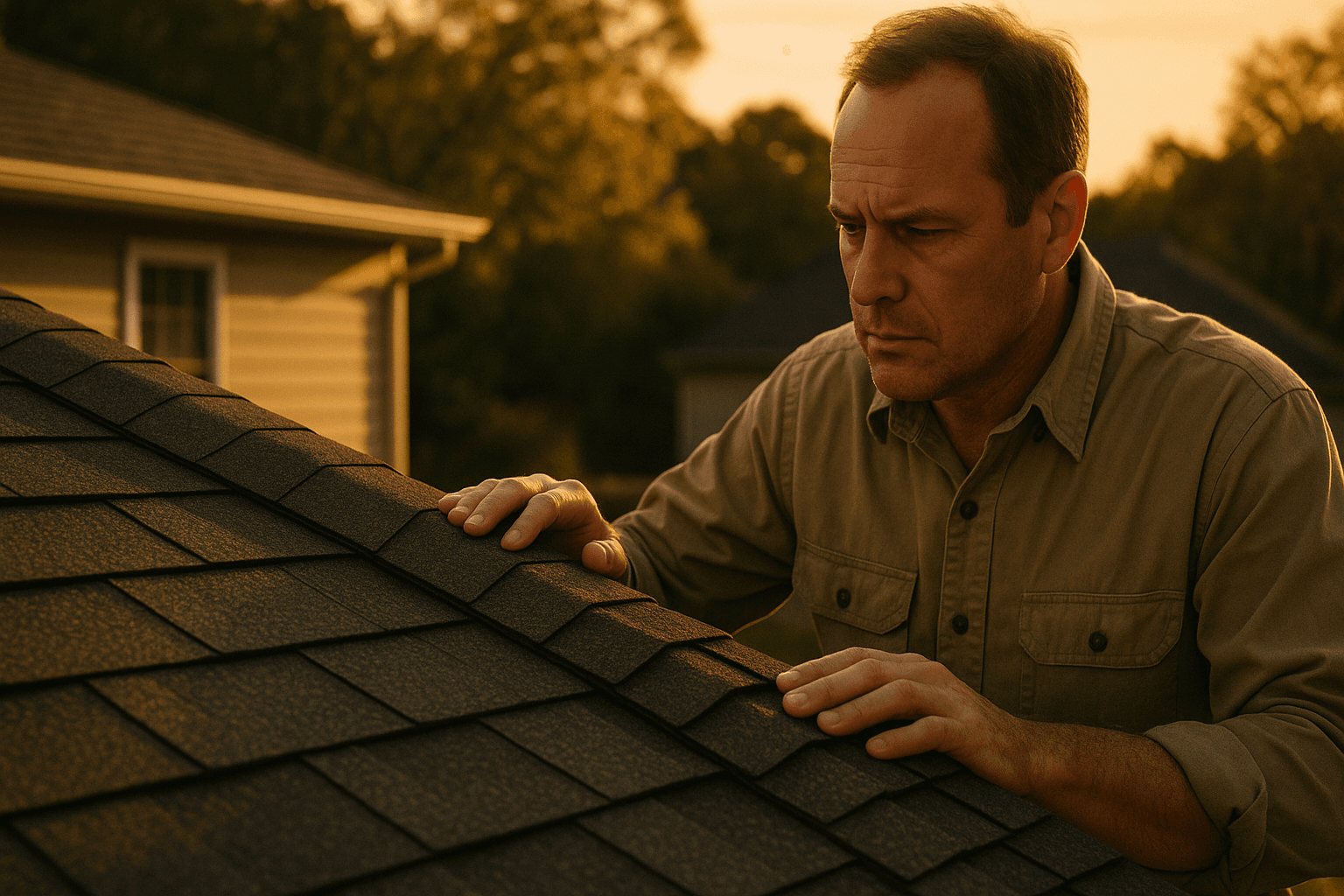
The default answer in 2026 is architectural shingles, and it's not close. A 3-tab shingle on a primary residence today is increasingly a niche choice — appropriate in a small set of circumstances (HOA matching, short hold time, very tight budget) but rarely the right call otherwise. The cost delta is modest, the lifespan delta is significant, and the wind-warranty delta turns severe-thunderstorm exposure from a coin flip into a non-event.
A 2,000 sqft 3-tab install runs $7,000-$9,000 in a moderate-cost market — call it the $12,500 national median 3-tab baseline scaled down for a smaller roof. An architectural install on the same roof runs $9,000-$13,000 (1.25× architectural premium on the baseline). The math is roughly $1,000-$2,000 more for architectural. The lifespan moves from 20-25 years to 25-30 years. That alone usually carries the decision.
What 3-tab actually means
A 3-tab shingle is a single-layer asphalt shingle with three uniform rectangular tabs cut into each course. Lay it on the deck and the pattern reads flat — no shadow lines, no dimensional depth, repetitive grid. Builder-grade homes from the 1980s through the early 2000s used 3-tab almost exclusively because it was cheap and the technology was mature. Many of those homes are now on their second or third 3-tab roof, and the homeowners replacing them in 2026 typically face a question: match the original spec or upgrade to architectural?
The 3-tab wind warranty caps at 60-70 mph in most product lines. Lifespan runs 20-25 years in a moderate climate, less in hot southern markets where UV exposure compresses the field outcome. The aesthetic is institutional — flat, regular, unembellished. It's not bad, it's just dated.
What architectural shingles actually deliver
Architectural shingles are laminated — two asphalt layers bonded together with random-cut tabs that create dimensional shadow lines mimicking cedar shake or thin slate. The thickness, the irregularity, and the depth read as a more substantial roof from the curb. Most architectural lines are 30-40% thicker than 3-tab and actually run twice the install lifespan in field conditions.
The wind warranty profile is the under-discussed advantage. Architectural product lines typically carry a 110-130 mph wind warranty — well above any severe-thunderstorm threshold and approaching Category-3 hurricane wind speeds. A 3-tab roof with a 60-70 mph warranty is below normal severe-weather wind in central states like Indiana, Missouri, Iowa, and Oklahoma. Lifted-tab and torn-off-tab claims after a single severe storm are common on 3-tab roofs and rare on architectural ones.
Lifespan in moderate climates runs 25-30 years. In hot, sunny states with intense UV (Arizona, Texas, Florida), expect compression to 22-27 years. In mild climates (Pacific Northwest, Northeast coastal), expect to hit the full 30 years. The architectural baseline outlasts the 3-tab baseline by 5-10 years on the same deck under the same conditions.
Why most installers default-quote architectural
Three reasons drive the default. First, the cost delta is small as a percentage of the total job. On a $12,500 baseline replacement, the architectural premium is $2,500 — a 20% bump that buys 25%+ more lifespan and a materially better warranty. The dollar-per-year-of-service math favors architectural cleanly.
Second, the warranty profile reduces the installer's repeat-claim exposure. A 3-tab roof that loses tabs in a 75 mph thunderstorm is a callback the installer often eats; an architectural roof in the same storm typically holds. Lower call-back rate is real margin.
Third, resale impact favors architectural in every market. Buyers reading an inspection report distinguish between "architectural shingles in good condition" and "3-tab shingles in good condition" — the first signals a quality roof, the second signals a builder-grade roof or a cheap rebuild. The resale lift on architectural typically recovers most or all of the install upcharge.
When 3-tab is actually the right answer
Three situations support 3-tab. First, deed-restricted HOAs that require matching the existing 3-tab look across the neighborhood — some pre-2005 developments wrote 3-tab into the covenants and approve nothing else. Second, short hold times under 5 years where the resale recovery on architectural doesn't materialize before sale. Third, hard budget constraints where the $2,000 delta is the difference between fixing the roof now and not fixing it. In that third case, 3-tab now is materially better than no roof now.
Outside those three, architectural is the default. If a 3-tab quote shows up on a proposal in 2026 without one of those reasons attached, ask why. Sometimes the answer is fine. Sometimes it's a roofer pricing to a number rather than spec'ing the roof the home actually needs.
For the full materials decision framework see materials. For replacement-cost regional spread and what each tier of shingle includes in the line-item spec, see replacement.
This is reference, not a quote.