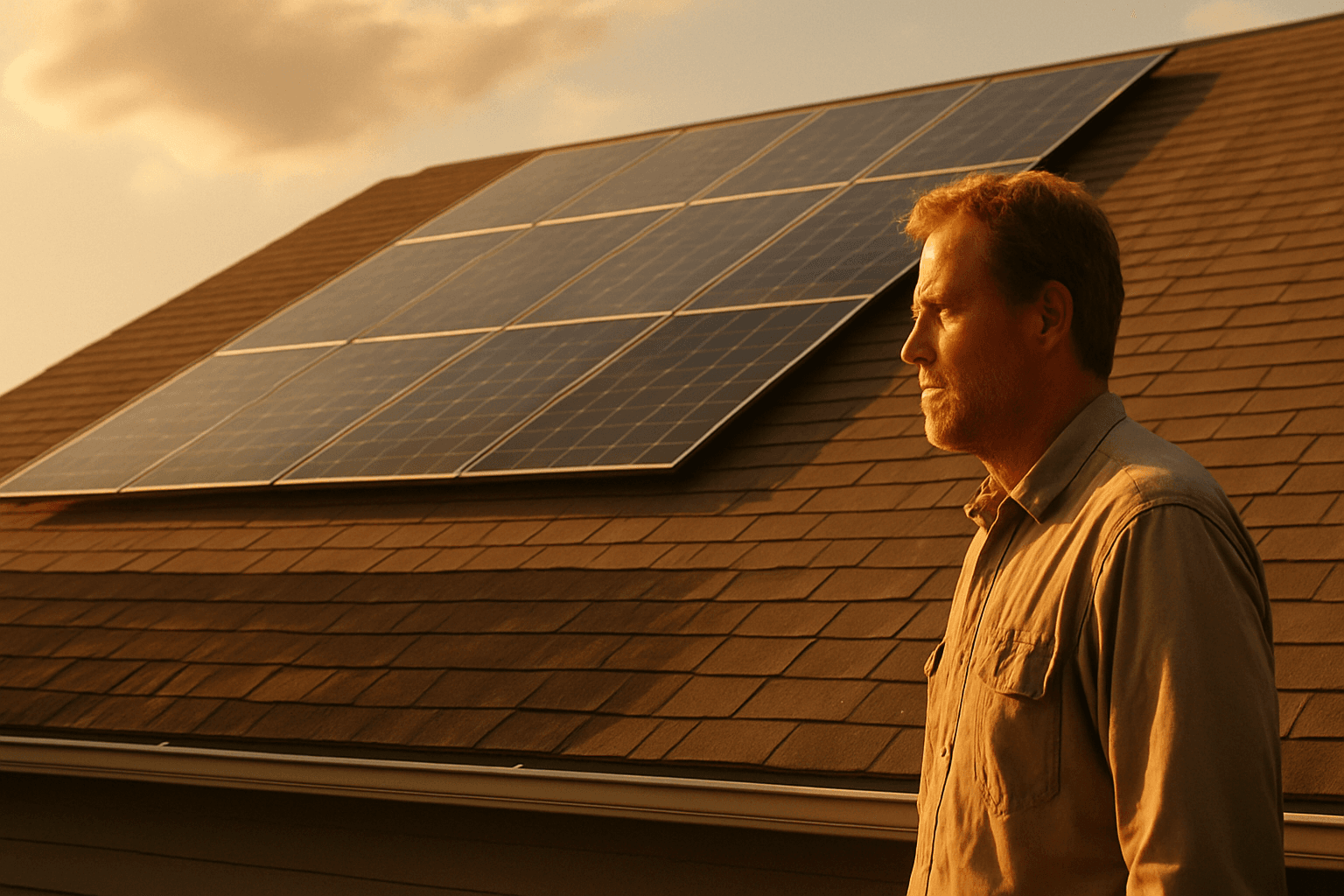
Yes — if your roof is under 5-7 years of remaining life and you're committing to a 25-year solar lease, PPA, or even a self-owned system, replace the roof first. The arithmetic is unforgiving. A solar array lasts 25 years. An asphalt roof in year 20 of a 25-year rated lifespan does not. Tearing the array off mid-cycle to replace the roof underneath runs $2,500-6,500 in labor — money that doesn't exist if the roof was replaced before the array went up.
The harder question is the middle case: a 10-15 year-old roof with maybe 12-15 years of life left. The math there runs differently, and the honest answer depends on how much remaining life the roof actually has, not how much the solar installer says it has.
The math on removal-and-reinstall
Solar panels on a residential roof are mounted with rail-and-clamp systems anchored to the rafters through the deck and shingle layer. To replace the roof underneath, the installer removes the panels (in reverse install order), removes the rails, removes the flashings around each penetration, removes the conduit runs at the array perimeter, and stages everything off-site. The roofer tears off, replaces underlayment and shingles, and re-flashes. The solar installer returns, replaces flashings, re-mounts the rails, and re-installs the panels — typically with new lag bolts and re-sealed penetrations.
For an 18-30 panel residential system, that's $2,500-6,500 in labor. Larger systems, more complex inverter architecture (micro-inverters mean more individual electrical reconnections), tile and metal roof underlayments, and ballast mounts on flat roofs can push the number to $8,000+. The panels themselves are not consumed — they're reused — but the labor is real and it's not amortized into the original install cost.
If the homeowner replaced the roof before solar, that bill never exists.
How PPAs and leases handle re-roof events
Read the contract clause titled "Owner-initiated panel removal" or "Re-roofing" — every PPA and lease has one, and the terms vary widely. Some PPAs include a one-time removal-and-reinstall allowance of $1,500-3,000, payable to the homeowner if a roofer documents the need to replace. Some charge full removal at then-current labor rates with no allowance. Some require 60 days' written notice. Some impose performance-shortfall penalties — if the array produces less than projected during the removal window, the homeowner pays the gap.
The worst-case clause: full-cost removal-and-reinstall on owner request, plus a production-shortfall penalty of $0.10-0.15/kWh against the projected output during the downtime, plus a re-permitting fee. That stack can run $8,000-12,000 on an array that would have been a $4,500 removal-and-reinstall in a clean contract.
If a homeowner is on the cusp of needing a new roof and the PPA contract has bad re-roof economics, the replacement hub framework usually says replace first — and use the cost calculator to confirm the savings against the PPA exit math.
Why warranty alignment matters
A 25-year solar panel warranty makes no sense on a roof with 5-7 years of remaining life. The panel keeps working long after the roof underneath has failed — at which point the homeowner pays to remove the still-warrantied panels, replace the roof, and reinstall them. The 25-year warranty is actually a warranty on the panel itself, not on the right to leave it on the roof for 25 years.
Replacing the roof first resets the warranty alignment. A new architectural asphalt roof carries a 25-30 year material warranty (Class 4 impact-resistant: 30-40 years; standing-seam metal: 40-50+). Putting a 25-year solar array on a 25-30 year roof aligns both end-of-life dates within a window that lets the homeowner make a single replacement decision when both fail. That's clean. The alternative — staggered replacement timelines — is the most expensive way to own residential solar.
The exception: a Class 4 or standing-seam roof with 35+ years of remaining life. There, the solar array will reach end of life before the roof does, and the next solar decision (in year 25) is whether to replace the array on the still-good roof or remove it entirely.
The inspection sequence that prevents mistakes
Before signing a solar contract, hire an independent roofer for a remaining-life inspection. Cost: $200-400. Output: a written estimate of years remaining, photos of granule loss, flashing condition, and any soft spots, and a recommendation to replace, repair, or proceed with solar. This is not the solar installer's roof inspection — they evaluate structural fitness for mounting, not material condition.
Bring the roofer's estimate to the solar consultation. If the solar installer says the roof is fine and the roofer's report says 5-7 years remaining, the lifespan hub and the replacement hub both call that a replace-first scenario. If the solar installer disputes the roofer's estimate without inspecting the roof themselves, that's a signal about the installer's incentives, not about the roof.
The single case where solar-first makes sense
Roof under 8 years old with no evident wear, in a low-hail/low-wind state, with a 30-40 year rated material. Skip the pre-emptive replacement, install solar on the existing roof, monitor through year 20, and decide on replacement when the roof shows wear. Most asphalt manufacturers explicitly cover panel-mounted roofs as long as the install uses approved flashing.
This is reference, not a quote. For the full replace-or-repair framework, see the replacement hub. For roof material rated lifespans, the lifespan hub carries the table.