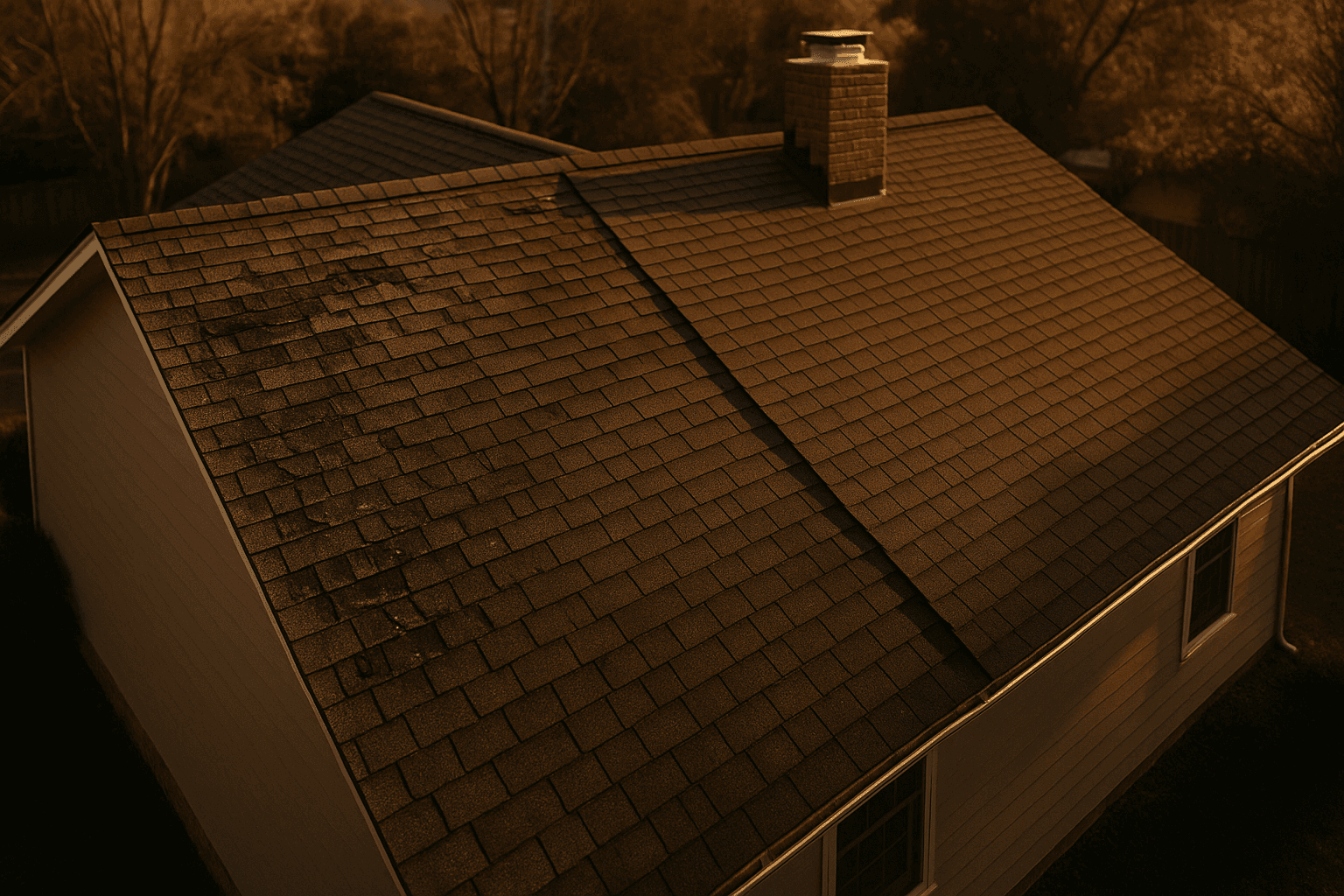
Replace when the roof has failed structurally or systemically. Repair when failure is localized and the rest of the roof has years of life left. The hard part is reading the difference honestly — and the honest read is rarely the one a roofer pitching a full replacement will offer.
Three signals push toward replacement. Three signals push toward repair. The math on remaining life and repair cost runs underneath both.
The three replacement signals
Age past 75% of rated lifespan. A 30-year architectural shingle hits the replacement window at year 22–23. A 50-year standing-seam metal hits it at 38. A 100-year slate roof, properly maintained, doesn't hit it at all in most homeowners' timeline. Lifespan is rated, not guaranteed — climate, ventilation, and install quality all move the number. See the lifespan hub for material-by-material rating ranges.
Failure cluster of two or more independent modes. One leak is a repair. One leak plus visible granule loss across three slopes plus ridge cap lifting in synchrony is a system that's failing in multiple places at once — and a system-wide failure means a system-wide replacement. The diagnostic question: are these failures connected (a single ice-dam event causing leaks at three valleys) or are they independent (the underlayment is breaking down and showing up everywhere)?
Structural drift. Visible deck sag between rafters, persistent ice damming on a properly insulated home, soft spots underfoot when the roof is walked. This is the deck telling you it's done. No amount of new shingle on top fixes a deck that has lost compression strength.
The three repair signals
Localized failure. One slope, one penetration, one storm-damaged area. The other 80% of the roof is clean — granules intact, no leaks, no lifting. This is a repair every time, not a replacement.
Recent install, no systemic defect. A roof under 8 years old that fails locally is a repair, full stop. The install carries some warranty in most cases. Even out of warranty, replacing an 8-year-old roof to fix one chimney leak is a financial mistake — that's not a roofer pitching a job, that's a roofer ignoring the math.
Upcoming move within 18 months. If the roof has 5+ years of remaining life and no active leaks, repair the cosmetic damage and let the buyer take the replacement. Most appraisers credit a "good condition" roof at full value even at 80% of lifespan.
The break-even math
The clean rule: when a single repair crosses roughly 30% of the replacement cost on the same roof, the math tips toward replacement. A $4,500 repair on a roof that would replace at $14,000 is already in replacement territory — even if the rest of the roof is technically fine. That money buys 3–5 years of held-together life. A new roof buys 25.
The exception runs the other direction. A $1,500 repair on a $13,000 roof — even if the roof is at 70% of lifespan — is a clean repair. The 30% threshold isn't crossed, the failure is local, and there's enough remaining life to amortize the patch. Repair, monitor, and revisit the replacement question in 3–4 years.
When "patch and live with it" is right
If the budget for replacement isn't there and the failure is localized, repair is the right answer — and there's no shame in it. A reputable roofer should be willing to quote a repair without trying to convert it into a replacement on the spot. If they refuse, that's a signal about the roofer, not about the roof.
For finding a roofer who'll quote both honestly, see find a roofer. For the full replacement framework and 2026 cost ranges, the replacement hub carries the math.