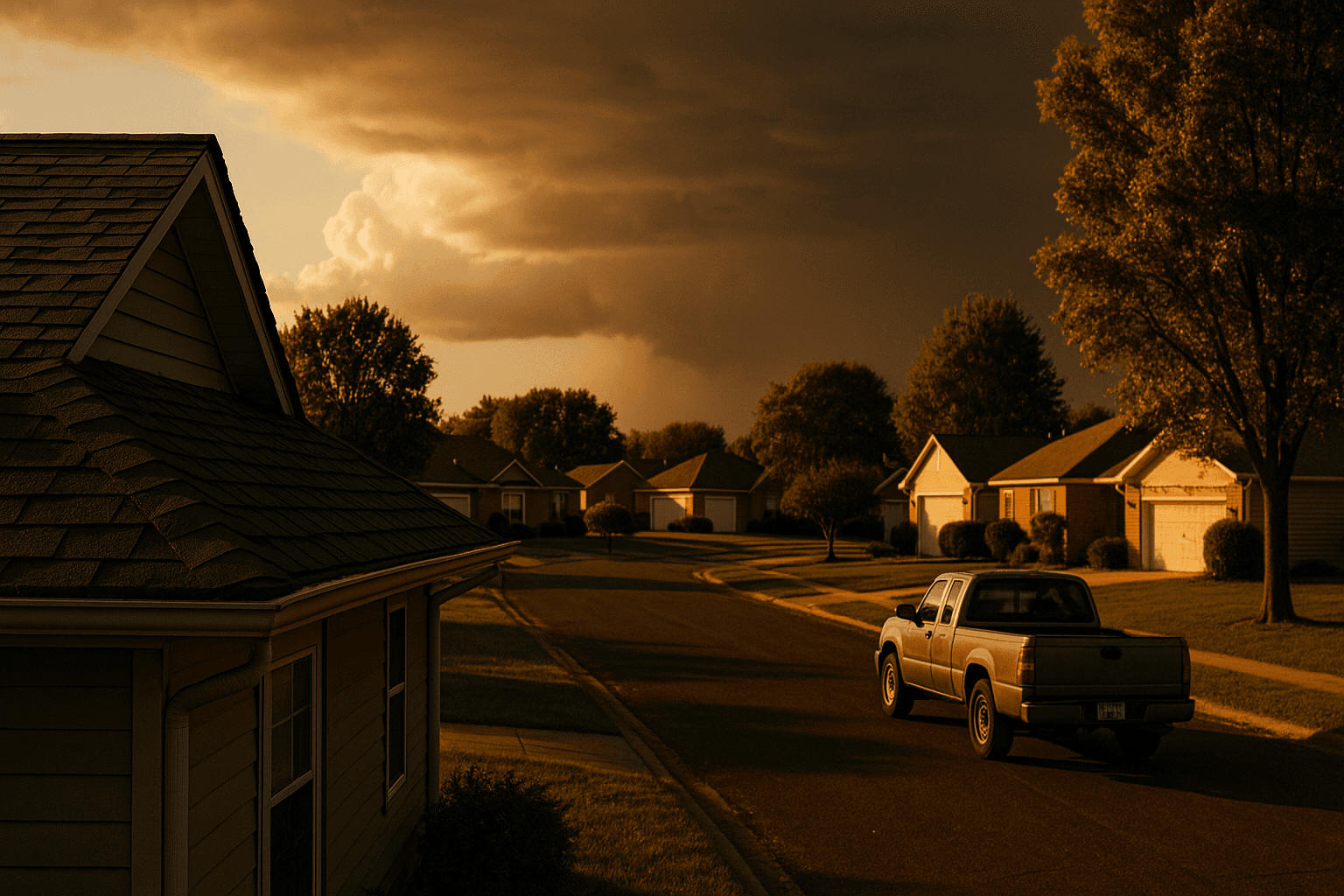
The honest answer is that storm chasers are roofers who travel into a hail or hurricane market for the post-storm spike, work without a local contractor license, leave before warranty claims surface, and often pressure homeowners to sign assignment-of-benefits paperwork before any actual damage inspection. The pattern is consistent enough that Colorado, Georgia, and Florida have all passed statutes specifically targeting it since 2021.
The pattern, in five signs
You can usually identify a storm chaser within the first 90 seconds of the conversation. The signals are:
- Out-of-state plates on the truck. A roofer driving in from a neighboring state is sometimes legitimate (border counties exist). A roofer driving in from three states away to work a market they've never operated in before, the day after a hail event, is not.
- Door-knocking immediately after the storm. Reputable local roofers fill their post-storm pipeline through standing referrals and homeowner-initiated calls. The contractor knocking on doors at 8 AM the morning after a hail event is staffing up for a temporary spike.
- The "free roof" pitch. "Your insurance will pay for everything — you'll have no out-of-pocket cost." This is a misrepresentation in most cases. Your deductible always applies, and many storm-chaser claims fail to clear it once the carrier inspects.
- Assignment-of-benefits paperwork before inspection. A storm chaser will hand you an AOB contract and ask you to sign before they've climbed your roof, before your carrier has assigned an adjuster, and before you've had time to call anyone else. AOB is the single biggest financial trap in residential roofing — see below.
- No permanent local office. Ask for the company's local address. If the answer is a P.O. box, a hotel, or "we operate out of a regional hub in [other state]," the contractor isn't local — meaning warranty claims in years 3-7 will go nowhere.
Why assignment of benefits is the biggest trap
AOB is a contract clause where the homeowner signs over their insurance-claim rights to the contractor. The contractor negotiates directly with the carrier, accepts whatever the carrier pays, and the homeowner is left liable for any shortfall — and loses the right to settle the claim independently.
In practice, the workflow runs like this. The roofer claims to see hail damage from the street, hands you an AOB form, you sign. The roofer files a claim in their own name. The carrier inspects, finds the damage doesn't warrant replacement, and offers a partial payment or denial. The roofer either accepts the partial and does a partial repair, or sues the carrier for "bad faith" and rolls fee multipliers into the homeowner's claim. You have no leverage at any point because you signed the AOB.
If a roofer hands you an AOB form, do not sign it. Tell them you'll call your carrier first and have your own adjuster do the inspection.
State crackdowns since 2021
The volume of abuse drove a wave of state legislation:
- Colorado HB 22-1149 (2022). Requires a written contract before any work, with explicit cancellation rights. Tightens AOB language and adds disclosure requirements on storm-restoration sales.
- Georgia SB 173 (2021). Added door-to-door solicitation restrictions after declared disasters. Mandates contract disclosures including cancellation periods.
- Florida HB 7065 (2022) + SB 2-A (2022) + 2023 follow-on. Significantly restricted AOB on residential property claims, capped attorney-fee multipliers, and added contractor-disclosure requirements after a decade of AOB-driven litigation pushed Florida property premiums to among the highest in the country.
Other hail-belt states have followed with narrower measures. Colorado is the canonical hail market — Denver and the Front Range pull storm chasers in from across the Mountain and Plains every year, which is why the state's county-level licensing plus HB 22-1149 exist as the response.
Why the install quality isn't even the biggest issue
A homeowner's instinct is to worry about whether the storm chaser will do a passable install. Sometimes they will — the work can be technically adequate on day one. The bigger risk is years 3-7, when underlayment errors or fastener corrosion start producing leaks.
When that happens, the local roofer is still in business and reachable. The storm chaser's phone number doesn't connect. The manufacturer warranty often won't help either — most major warranties have "authorized installer" or "licensed contractor" clauses that are voided when the work was done by an unlicensed out-of-state crew. The leak that surfaces in year five is now a year-five leak with no contractor recourse, no warranty path, and a five-year-old install an honest local roofer will quote at full replacement to redo.
What to do at the door
If a roofer knocks on your door after a storm: ask for the state license number, verify it on your state contractor licensing board, ask for the local address (not a regional headquarters), refuse to sign anything until you've called your carrier and assigned your own adjuster, and ask for three local references over two years old — storm chasers can't produce these because they weren't in your market two years ago.
If any step fails, the conversation is over. The homeowner who waits a week to find a reputable local roofer comes out ahead of the homeowner who signs an AOB at the door. This is reference, not a quote — and the verification stack is the same whenever you meet a roofer.