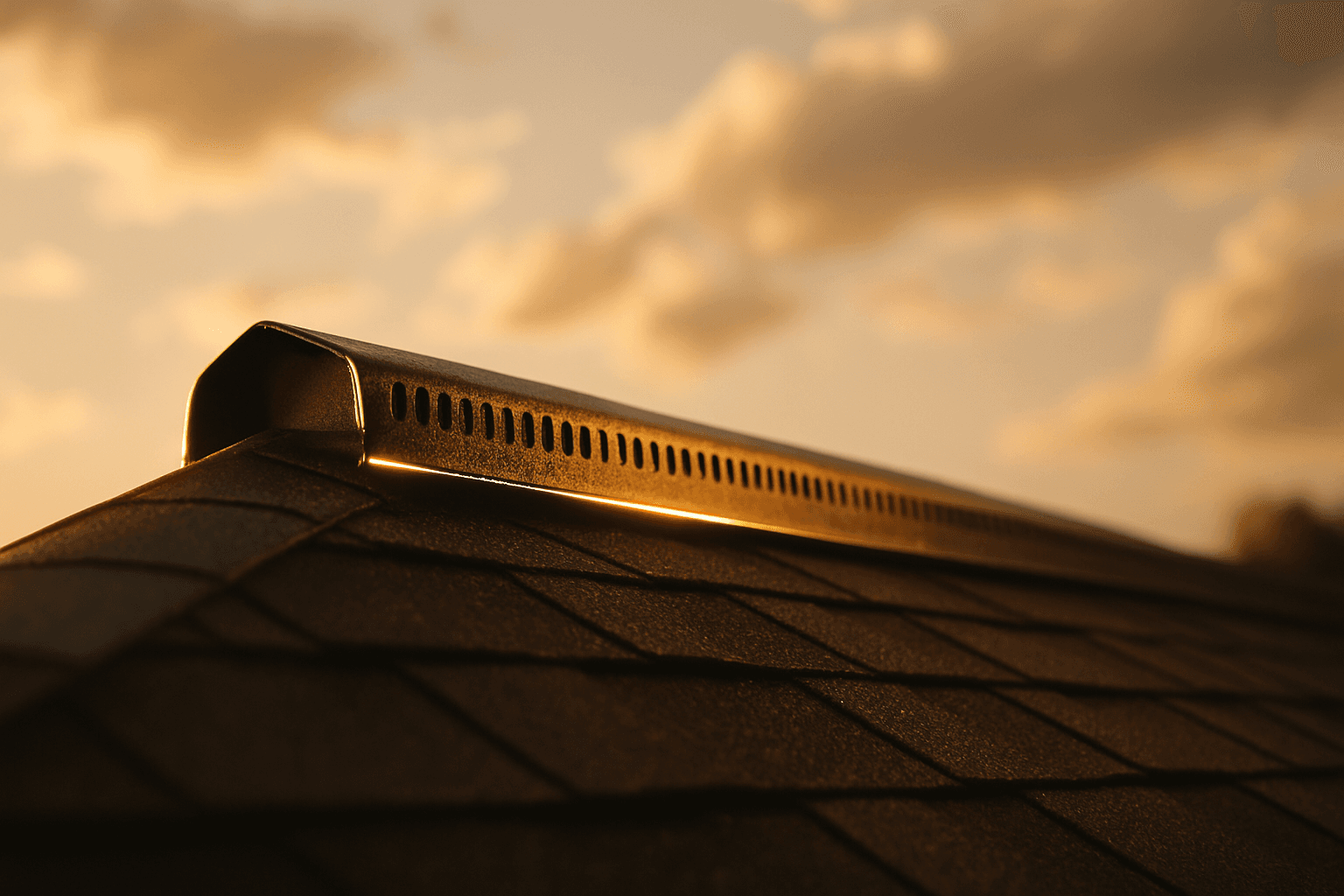
Roof ventilation is continuous airflow through the attic — cool air entering at the eaves through soffit vents, warm air exiting at the peak through ridge or gable vents. The system runs passively when wind passes over the ridge and creates a slight pressure differential. Done correctly, it flushes summer heat and winter moisture before either can damage the deck or the shingles. Done incorrectly — or not done at all — it cuts asphalt-shingle lifespan by 5-10 years.
Most homes built before 2005 are under-ventilated. Most homes built since 2005 have the parts but not the balance.
The 1:300 rule (and when it becomes 1:150)
The International Residential Code threshold is one square foot of net free vent area per 300 square feet of attic floor — written as 1:300. The 1:300 ratio applies only when two conditions are met: a Class I or II vapor retarder on the warm-side ceiling, and balanced intake/exhaust split (50/50, or at minimum 40% at the eaves and 60% at or above the upper third of the roof). Without the vapor retarder, code defaults to 1:150 — twice the vent area — because the attic now has to handle moisture migrating up through the ceiling.
The math for a 1,500 sqft attic at 1:300: 5 sqft of net free area, ideally 2.5 sqft intake at the soffit and 2.5 sqft exhaust at the ridge. That typically works out to about 25-30 linear feet of ridge vent and 30-50 linear feet of soffit vent — depending on the manufacturer's net free area rating per linear foot.
Net free area is the actual open opening, not the gross size of the vent. A 16-inch soffit vent advertised as 26 square inches of net free area is a different number than the 64 square inches of gross opening. Read the spec sheet, not the box.
Intake versus exhaust — and why balance matters
The two halves of the system have to be roughly equal in net free area for the airflow to work. Imbalanced systems short-circuit. A common failure mode: a homeowner adds a ridge vent without verifying that soffit intake exists. The ridge vent now pulls air through whatever path is easiest — typically backward through the nearest gable vent or through gaps in the ceiling — instead of pulling fresh air through the soffit. The attic still doesn't flush.
The opposite failure shows up too. A house with adequate soffit vents but no ridge vent or only a small gable vent ends up with cool air entering the attic and stalling. Without an exhaust path, intake doesn't move air; it just sits there.
When intake and exhaust are balanced, the attic temperature in summer runs 15-25°F closer to the outside temperature than an unventilated attic. That temperature differential is what determines whether the asphalt shingles cook from the underside or breathe.
Common failure modes
Blocked soffit vents. The most common ventilation failure in any home with blown-in attic insulation. Insulation falls into the soffit channel without an installer-placed baffle, and the intake stops working. The vent looks fine from outside; it's blocked from inside.
Mixed exhaust types fighting each other. Stacking a ridge vent, gable vents, and a powered attic fan on the same attic creates competing exhaust paths. The ridge vent pulls from the gable vent (the path of least resistance) instead of the soffit. The gable vent doesn't reverse direction; it stays pulling air the wrong way. The attic doesn't flush.
Undersized ridge vent. Manufacturer-rated ridge vent typically delivers 9-18 sqin of net free area per linear foot. A 25-foot ridge run with a low-rated product delivers 1.5-2 sqft of net free area — well below the 2.5 sqft a 1,500 sqft attic needs.
Powered attic fans running on a broken thermostat. Powered fans that don't shut off properly in winter pull warm conditioned air out of the living space and into the attic, where it condenses on the roof deck and rots it. This is a known and well-documented failure mode in homes with underperforming attic thermostats.
How to inspect ventilation yourself
Three diagnostics, no contractor needed:
Attic temperature differential. On a hot summer afternoon, climb into the attic with an outdoor-temperature reference. A correctly ventilated attic runs within 15-25°F of outdoor; a poorly ventilated attic runs 40-60°F hotter.
Condensation on rafters. On a cold winter morning, shine a flashlight at the underside of the roof deck. Look for moisture beads, dark staining trails on rafters, or rusted nail heads. Any of those signal trapped moisture, which means the ventilation isn't flushing winter humidity.
Ice dam history. If you've had two or more ice-dam events in the last five years and the attic insulation looks adequate, the more likely fix is ventilation, not more insulation. See the replacement hub for ventilation upgrades during full reroofs and the materials hub for material-specific ventilation considerations on metal versus tile versus asphalt.
Why this matters for lifespan: under-ventilated asphalt-shingle roofs in identical climates consistently fail 5-10 years earlier than code-meeting balanced-vent roofs. The IBHS and NRCA both have data on this. Ventilation upgrades during a reroof typically add $300-800 — the highest-ROI dollar in the entire job. This is reference, not a quote.