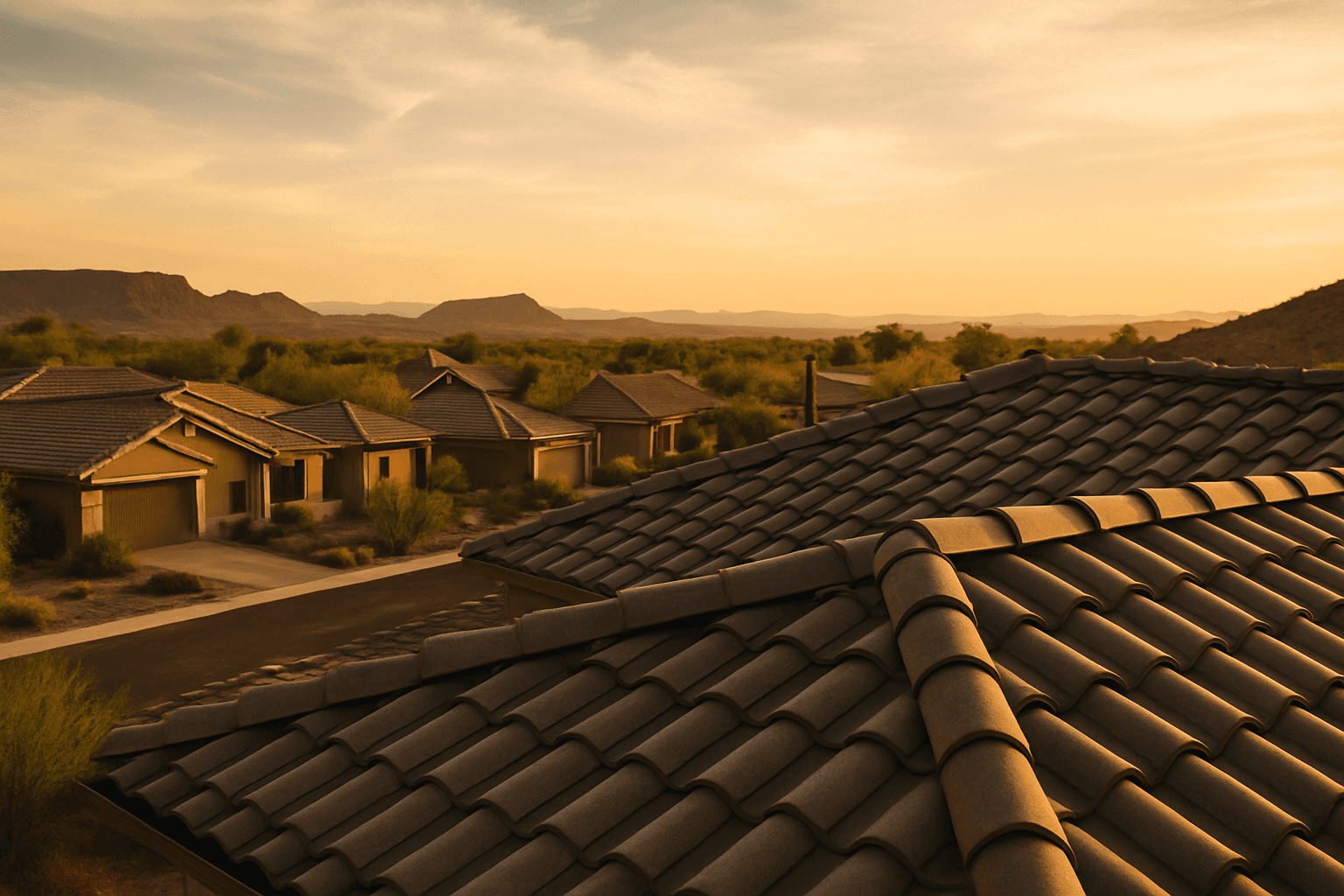
Arizona is the rare state where the dominant roofing material isn't asphalt shingle. Concrete tile holds 42% of the residential market, with architectural asphalt at 38% and standing-seam metal at 12% — a distribution driven directly by what the Sonoran climate does to roof surfaces. Replacement runs $11,000–$22,000 (2026 estimate) for a 2,000 sqft tile roof, with a median near $14,500. Arizona is a state-licensed contractor jurisdiction (ROC — Registrar of Contractors), and that license should be the first thing a homeowner verifies before signing anything.
The Southwest 2B climate zone is hot and dry, and that combination produces a specific set of failure modes. UV degradation is the headline. South- and west-facing asphalt slopes lose granules and brittle out 5-7 years sooner than the same product in a moderate climate — a 30-year architectural shingle in Phoenix is functionally a 22-25-year roof. Concrete tile sidesteps the UV problem entirely, which is why it dominates the market here despite higher upfront cost. Hail and wind risks are both low-tier statewide, so the dollar going into wind-mitigation upgrades elsewhere goes into UV-resistant material specification in Arizona.
What actually fails on a tile roof
The misconception about tile is that the tile is the waterproofing. It isn't. Concrete and clay tiles shed bulk water but the actual waterproof layer is the underlayment beneath them — typically a 30-40-pound felt or a synthetic membrane with a 20-30-year service life. Tiles routinely outlast two underlayments. So the meaningful Arizona roof project is often "lift the tile, replace the underlayment, re-lay the same tile" rather than a full material replacement, and a competent ROC-licensed contractor will frame the bid that way. If you're getting quotes that strip and replace the tile itself on a 25-year-old roof with intact tiles, get a second opinion.
Solar, 2026
Arizona has no surviving statewide residential solar incentive program in 2026 — the federal residential ITC expired 12/31/2025, and Arizona's net-metering structure (technically Net Billing, not full net metering, since 2017) credits exported power below retail rates with annual reconciliation. APS and TEP have utility-specific tariff treatment that varies more than people realize. Solar still pencils for many Arizona homeowners on the avoided-cost math alone — the sun resource is genuinely excellent — but the payback timeline now runs longer than installers' pre-2026 pitches suggest. Run the numbers against current utility rate schedules, not against a federal credit that no longer applies.
This is reference, not a quote — site-specific bids will vary with tile type, slope, and underlayment condition.