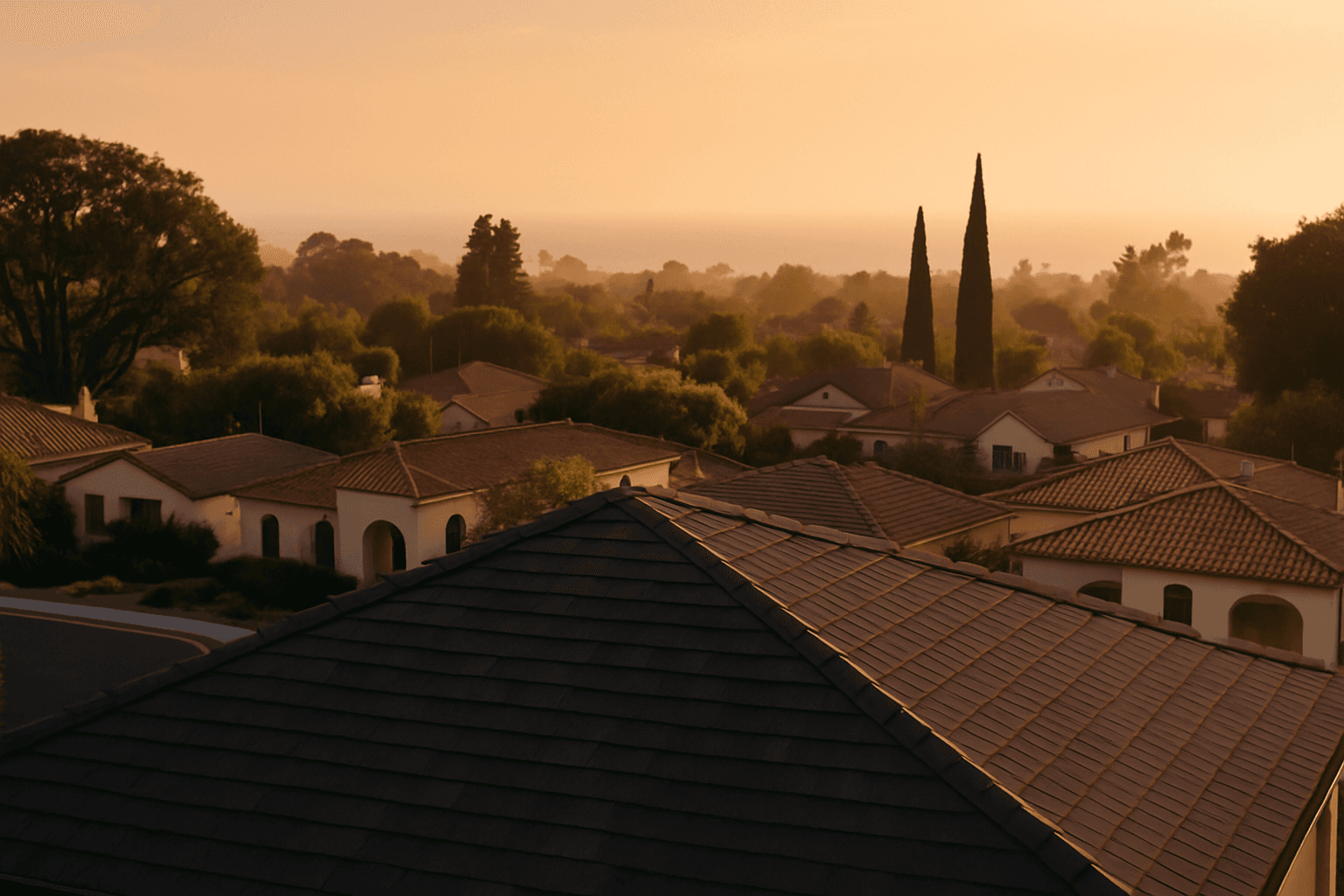
California is the highest-cost roofing market in the continental United States. Replacement runs $14,000–$30,000 (2026 estimate) for a 2,000 sqft roof, with a median near $19,500. The premium is driven by labor rates, prevailing-wage requirements on permitted work, Title 24 energy-code compliance, and — in WUI (Wildland-Urban Interface) zones — Chapter 7A ignition-resistance requirements that already mandate Class A roof assemblies and ember-resistant detailing. Material market share is asphalt architectural at 55%, concrete tile at 22%, and standing-seam metal at 14%. California is a state-licensed contractor jurisdiction under the CSLB (Contractors State License Board), and the CSLB license-lookup tool is the most useful 30 seconds a homeowner can spend before signing.
The Pacific 3C climate zone is mild on its own terms — hail is low-tier statewide, wind is moderate. The structural failure modes are different than in storm-belt states. Coastal salt corrosion on metal flashings and fasteners shortens galvanized service life noticeably. Inland UV exposure on south and west slopes degrades dark asphalt. And in WUI fire zones, ember intrusion through standard ridge vents is a documented loss mode — homes lost in major California wildfires routinely show roof-deck ignition rather than direct flame impingement.
What WUI compliance actually requires
If your home is in a designated WUI zone, a re-roof permit triggers Chapter 7A requirements: Class A roof assembly, ember-resistant vents (typically with 1/8-inch mesh or baffled designs), and non-combustible gutters or gutter guards. Older Class B or C roofs that were grandfathered in are not grandfathered through replacement. The cost premium for code-compliant WUI assemblies runs $2,000-$5,000 over a standard architectural shingle install on the same square footage. A contractor who tells you they can re-roof to the old spec without permits in a designated WUI zone is either ignorant of current rules or willing to put your homeowner's coverage at risk.
Solar, 2026 — the rare state with surviving programs
California is one of the few states where solar economics still pencil meaningfully in 2026. The federal residential ITC expired 12/31/2025, but the surviving California-specific structure includes: DAC-SASH (low-income-only no-cost solar program), the Self-Generation Incentive Program (SGIP) battery-storage rebate, and NEM 3.0 — which is partial net metering with substantially reduced export-credit values vs the prior NEM 2.0 regime. The honest read on NEM 3.0 is that solar-only payback runs noticeably longer than installers' NEM-2.0-era pitches, but solar paired with battery storage (with SGIP rebate stacked) preserves much of the prior economics by shifting consumption to higher-value evening rates.
California has no SREC market — the value flows entirely through the net-billing structure and the storage rebate. If an installer is quoting a payback period that sounds like it's still 2024, ask them whether they've modeled NEM 3.0 export rates and TOU evening peak — the right answer involves both.
This is reference, not a quote — California costs vary widely by region, and a CSLB-licensed contractor's site bid is the only number worth budgeting against.