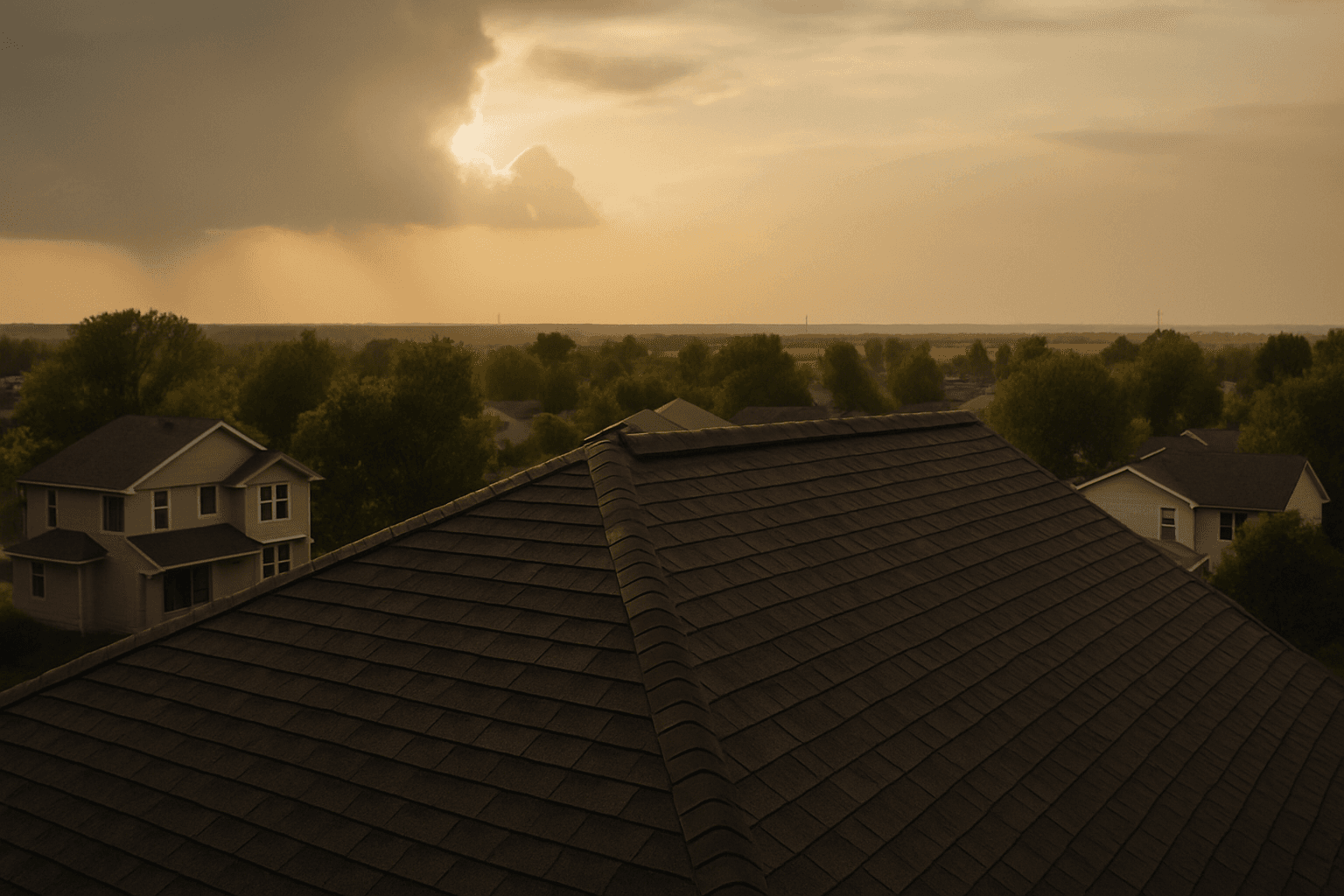
Kansas sits at the meteorological center of the country's worst hail belt, and that single fact shapes everything about how roofs are built, insured, and replaced here. The state's Plains 4A climate combines extreme hail frequency with the severe straight-line winds and tornado activity that define the central plains, which is why Class 4 impact-resistant asphalt shingles already account for roughly 55% of the local roofing market — a share you don't see outside the hail-extreme states. Replacement here runs $9,500–$18,000 (2026 estimate) for a 2,000 sqft asphalt roof, with a median near $12,500. Kansas is a county-licensed jurisdiction, not state-licensed, which is a meaningful distinction once storm season starts.
The dominant failure mode here isn't age. It's a single hail event. A 1.5"-diameter hail strike will functionally end the service life of a standard architectural shingle even when it still looks intact from the ground — the granule loss exposes the asphalt mat to UV and water in a way that runs out the remaining warranty in two or three summers. This is why the Class 4 upgrade pays back faster in Kansas than the sticker premium suggests.
The percentage-deductible trap
Wind/hail percentage deductibles are standard on most Kansas residential policies, particularly across the Wichita and Kansas City metros. A 1-2% wind/hail deductible on a $350,000 home is $3,500–$7,000 out-of-pocket before the carrier pays the first dollar, and that's before the depreciation hit on an actual cash value (ACV) endorsement. Read the declarations page. If the policy reads ACV on roof, the carrier pays the depreciated value of the damaged shingles — not replacement cost — and the gap on a 12-year-old roof can exceed the deductible itself.
The other Kansas trap is storm-chaser activity. After a major hail event in Wichita, Topeka, or the KC suburbs, out-of-state contractors with door-to-door crews show up within days, sign homeowners to assignment-of-benefits agreements, and disappear once the claim closes. County licensing means verification has to happen at the county level, and most homeowners don't know to do it. Stick with a contractor whose business address has been in the county for at least three years.
Solar in Kansas, 2026
Kansas has no surviving state-level solar incentives in the post-ITC environment — no SRECs, no state tax credit, no statewide rebate program. The federal residential solar Investment Tax Credit expired 12/31/2025, which means payback in Kansas now runs entirely on net-metering credits against avoided electricity cost, and Evergy's net-metering treatment varies by tariff class. For most Kansas homeowners in 2026, solar still pencils on a long horizon, but the case is meaningfully weaker without the federal credit and no state incentive to fill the gap.
This is reference, not a quote — your roof's specific replacement cost depends on pitch, layers, decking condition, and access.