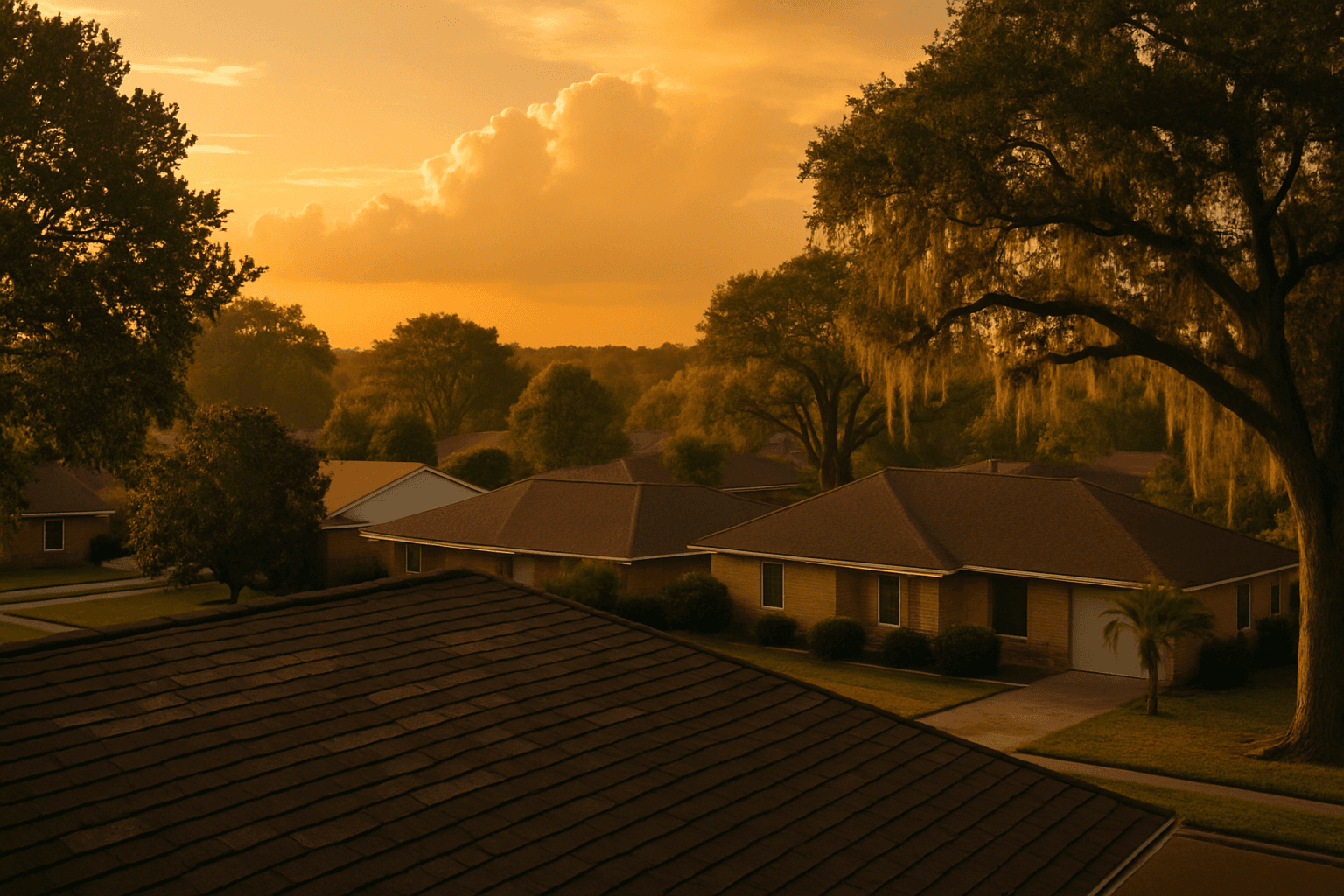
Louisiana's roofing reality is built around a single recurring problem — major-hurricane wind exposure on a Gulf Coast 2A climate — and every other variable is downstream of it. Hail frequency is low. What ends a Louisiana roof is a named storm with sustained winds in the 110–150 mph range, and the entire post-Katrina building code regime is organized around that fact. Replacement here runs $9,500–$18,500 (2026 estimate) for a 2,000 sqft asphalt roof, with a median near $12,500. Asphalt architectural shingle still holds about 62% of the market, but standing-seam metal has climbed to roughly 22% and is the fastest-growing category in coastal parishes. Louisiana is a state-licensed contractor jurisdiction, and that licensing matters more here than almost anywhere else.
The post-Katrina building code update raised minimum wind ratings in much of southern Louisiana to 130 mph or higher, with stricter sheathing-attachment, secondary-water-barrier, and ring-shank-nail requirements. A roof installed to legacy pre-2006 standards in St. Bernard, Jefferson, or Orleans Parish actually presents a different risk profile than one installed to current code, even if both look identical from the street — and several Louisiana carriers underwrite that distinction directly through wind-mitigation credits that can shave 15-30% off the wind portion of the premium.
The hurricane-deductible trap
Louisiana residential policies layer separate named-storm deductibles on top of the standard all-other-perils deductible, and the named-storm portion is almost always a percentage rather than a flat dollar amount. Common structures are 2%, 3%, or 5% of the dwelling coverage limit — meaning a 5% named-storm deductible on a $300,000 home is $15,000 out-of-pocket before the insurer pays the first dollar, in addition to whatever the AOP deductible runs. Read your declarations page carefully.
The other Louisiana reality is the carrier-availability problem. After successive hurricane seasons in 2020-2021, the market saw multiple insolvencies and significant non-renewal activity, and the state-run Citizens insurer has become the default for thousands of coastal policyholders. Citizens wind/hail rates and deductible structures are typically less generous than the standard market — and the wind-mitigation credit becomes that much more valuable. Standing-seam metal rated to 130-150 mph with hurricane-clip attachments can recover a meaningful portion of its upfront premium over a 7-10 year horizon.
Solar in Louisiana, 2026
Louisiana has no surviving state-level solar incentives in the post-ITC environment — no SRECs, no state tax credit, no statewide rebate program. The federal residential solar Investment Tax Credit expired 12/31/2025, and Louisiana's net-metering rules were rolled back in 2019 from full retail to a lower export-credit rate. For most Louisiana homeowners in 2026, the post-ITC math is not favorable — payback periods that ran 8-10 years under the credit now stretch into the 14-18 year range. Wait until the utility-cost picture shifts, or pair solar with storage to self-consume rather than export.
This is reference, not a quote — your roof's specific replacement cost depends on pitch, layers, decking condition, and access.