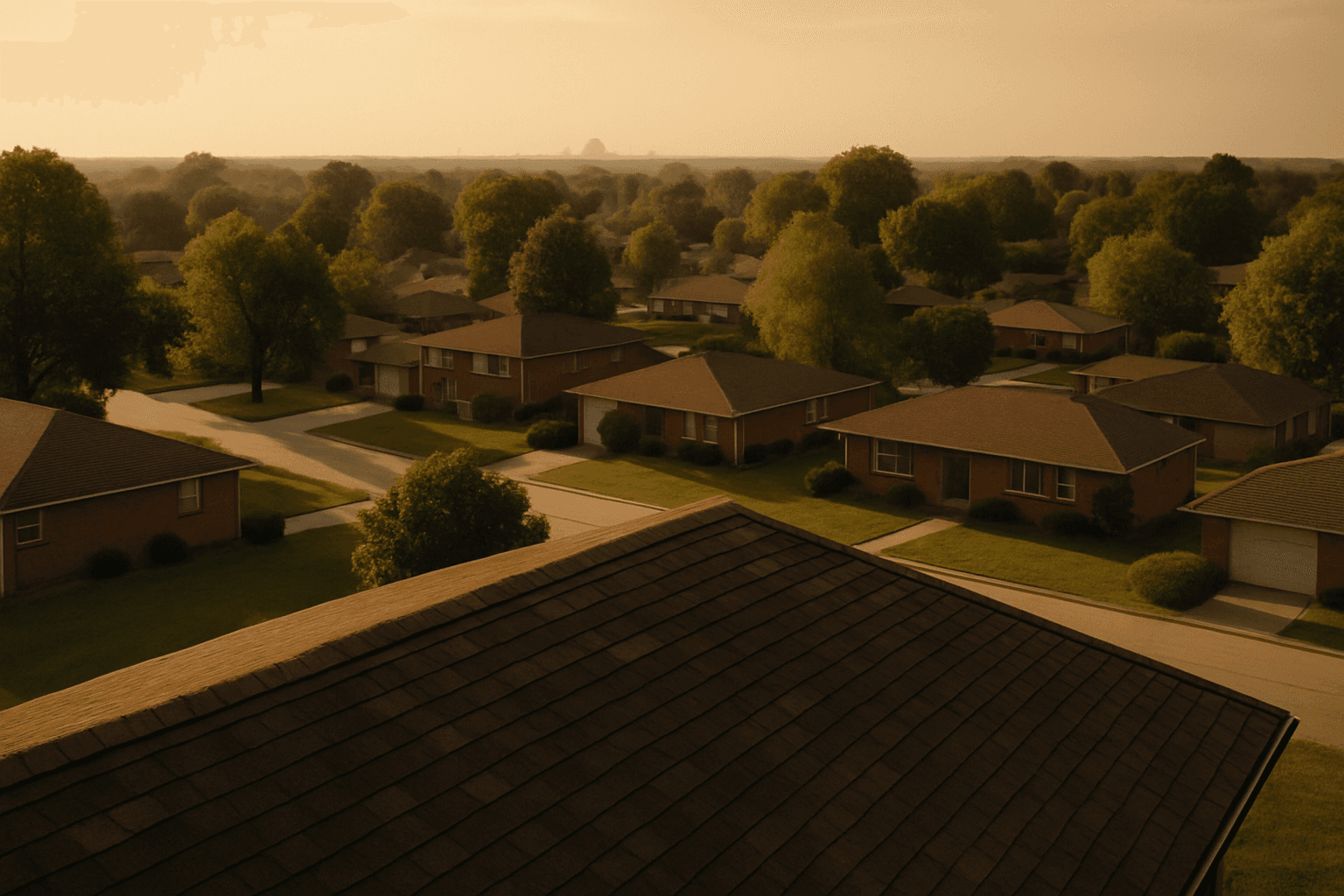
Missouri sits at the geographic heart of hail alley, and that single fact reorganizes nearly every roofing decision a homeowner here will make. The state's hail-risk tier is Extreme — top of the national scale — and wind exposure runs Severe under NOAA's tornado-belt classification, with the Kansas City and St. Louis metros both regularly documented in NOAA Storm Events as multi-hail-day annual environments. Replacement costs run $9,000–$17,500 (2026 estimate) for a 2,000 sqft asphalt roof, with a median near $12,000, slightly below the national $12,500 baseline. Missouri is a county-licensed jurisdiction rather than state-licensed, which has practical consequences after a documented hail event — a contractor working on your house in Jackson County may hold no license recognized in St. Louis County 250 miles away.
The dominant failure mode here isn't slow degradation; it's the sudden hail event followed by an insurance settlement and a re-roof, repeating on a roughly 8-15 year cycle in the worst-affected metros. Granule-loss patterns on standard asphalt accelerate sharply after a moderate hail event even when the roof passes a visual inspection from the ground, and the cumulative damage from successive sub-claim-threshold storms often only becomes apparent at the next major event. This is the reason Class 4 impact-resistant asphalt has gained meaningful share across Missouri's Extreme-hail counties, with most major carriers — State Farm, Allstate, USAA, Farmers — offering premium discounts in the 10-30% range for verified Class 4 installations. The discount only posts when the installer documents the product class on the certificate of completion and the carrier confirms it on the policy.
The storm-chaser problem and Missouri's regulatory gap
The combination of frequent hail, a high-volume claim environment, and county-level rather than state-level licensing makes Missouri one of the most active storm-chasing markets in the country. Out-of-state crews surge into the Kansas City and St. Louis suburbs within days of a documented event, pitching free inspections, "no out-of-pocket" replacements, and offers to absorb or rebate the homeowner's deductible. Missouri RSMo 407.725 makes the deductible-rebate offer illegal, and several local jurisdictions — Kansas City and St. Louis County in particular — have layered on additional registration requirements. Verify the contractor's license at the specific county building department where the work will be permitted, and walk away from any offer to waive the deductible.
Solar in Missouri, 2026
Missouri has no surviving state-level solar incentive programs in the post-ITC environment — no SREC market, no statewide rebate, and net-metering treatment that varies by utility under PSC rules, with Ameren Missouri and Evergy each running their own distributed-generation tariffs. The federal residential solar ITC expired 12/31/2025. Combined with hail risk that complicates panel-warranty economics — a 25-year array on a roof in an Extreme-hail county is a real underwriting question — residential solar in 2026 Missouri typically runs paybacks in the 13-16 year range. If you're due for replacement, do the roof first and consider Class 4 product before adding panels. This is reference, not a quote.