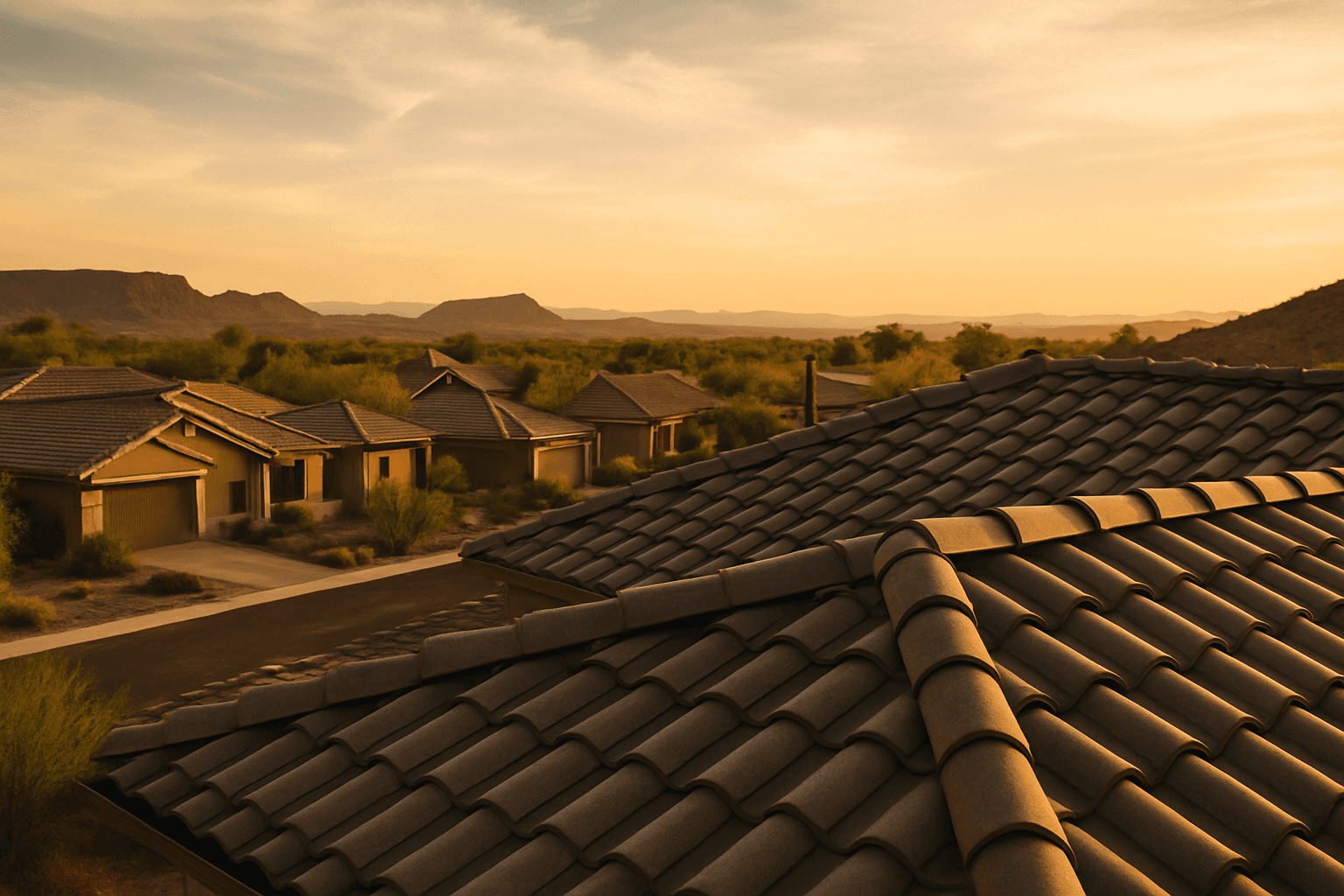
New Mexico sits in IECC climate zone 4B with moderate hail and moderate wind risks, which sounds unremarkable until you account for what high-desert sun and altitude actually do to a roof. Replacement runs $10,500–$19,500 (2026 estimate) for a 2,000 sqft asphalt baseline, with a median near $13,500. Material distribution is unusually mixed for the region — architectural asphalt holds 45% of the market, concrete tile another 22%, and standing-seam metal 18% — reflecting the way Albuquerque, Santa Fe, and Las Cruces homeowners spread their bets across UV durability, fire resistance, and upfront cost. New Mexico is a state-licensed contractor jurisdiction through the Construction Industries Division (CID), and the license number belongs on the contract, the permit, and the proof-of-insurance certificate before any tear-off begins.
Heat and UV are the dominant failure modes
The headline failure mode is not hail damage or wind uplift — it's solar exposure. At 5,000-plus feet of elevation across most of the state, UV intensity is meaningfully higher than at sea level, and the dry air does nothing to filter it. South- and west-facing asphalt slopes lose granules and oxidize the asphalt binder several years sooner than the same product would in a temperate climate. A 30-year architectural shingle on a Santa Fe roof is realistically a 20-25-year roof. Daily summer temperature swings — 95°F at 4 PM, 55°F at 4 AM — drive expansion-contraction stress cycles that fatigue flashings, ridge caps, and pipe boots faster than many installers warn customers about. Concrete tile and standing-seam metal both sidestep the UV-degradation problem, which is why they hold a larger combined market share here than in most of the country.
Solar economics after the federal credit expired
The federal residential solar ITC ended on December 31, 2025. What survived in New Mexico is genuinely useful: the state Solar Market Development Tax Credit, worth 10% of system cost capped at $6,000, remains active for residential installs, and full retail net metering is still the default rule for the major investor-owned utilities (PNM, El Paso Electric, Xcel Texas-NM). That combination — a state-level credit plus sustained retail-rate export credit — keeps New Mexico inside a small group of states where the post-ITC payback math still works on its own terms. The honest 2026 framing: a Santa Fe or Albuquerque homeowner with a south-facing roof in good condition and a $6,000 state credit applied to a $20,000 system is looking at payback windows competitive with what national installers were quoting before the federal credit lapsed. Run the numbers against current utility tariffs, not against a federal credit that no longer applies. On a tile or metal re-roof, also confirm whether the existing underlayment is being replaced — that membrane is the actual waterproof layer and typically wears out before the tile does. This is reference, not a quote.