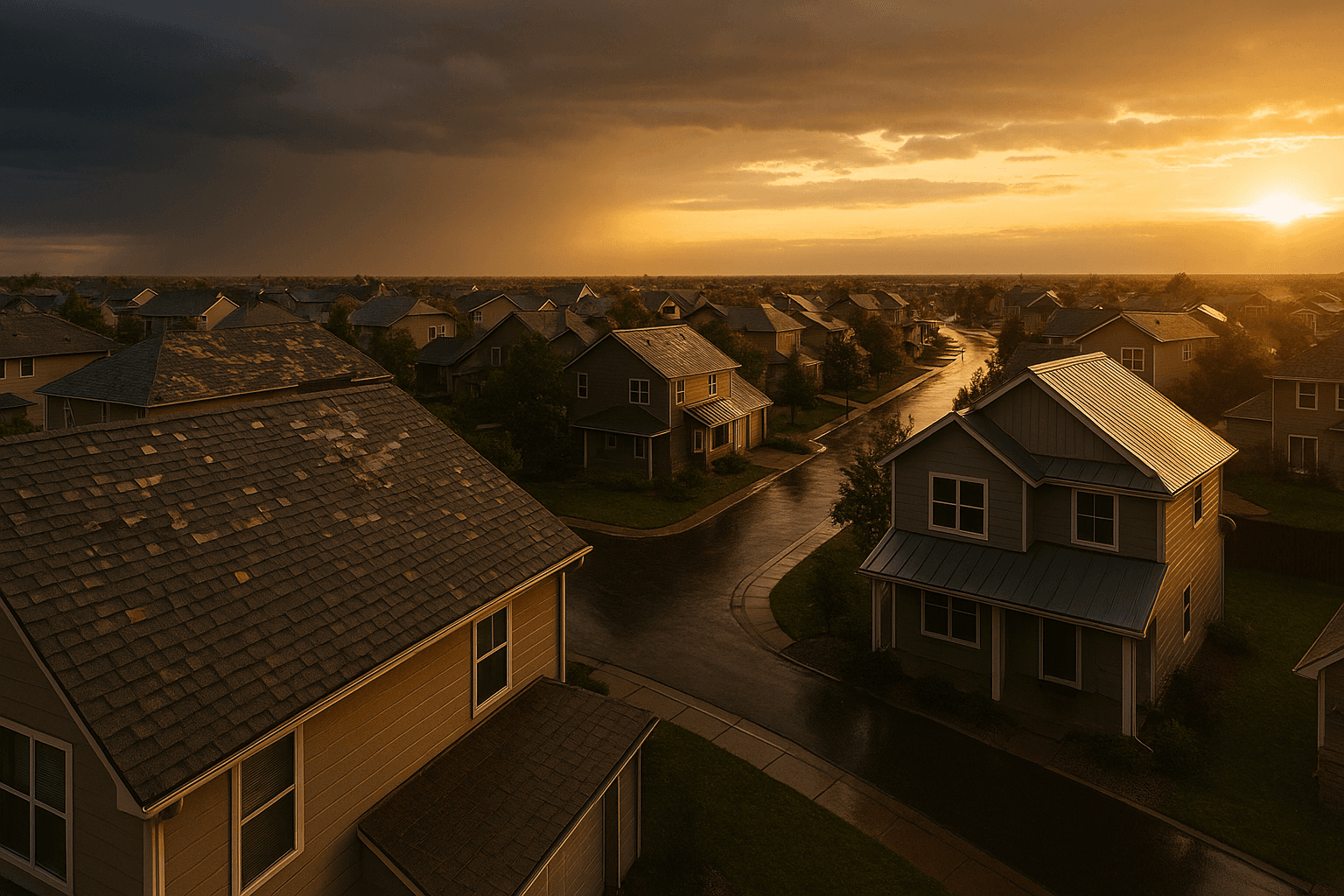
The honest answer to best roofing material for hail depends on the budget tier, the climate beyond hail, and how often hail actually hits the address. In Extreme-tier hail markets — Colorado, Kansas, Nebraska, Iowa, Missouri, Oklahoma — most asphalt roofs see at least one significant hail event in their lifespan, and Class-4-saturated markets like the Front Range have shifted Class 4 asphalt from a premium upgrade to the de facto default spec. In moderate-hail and low-hail markets, the spec relaxes accordingly.
Three materials lead the residential hail-resistance list. Class 4 impact-resistant asphalt at the cost-balanced tier. 24-gauge standing-seam steel at the durability-first tier. Concrete or clay tile in low-hail/high-wind markets where hail is rare and tile's wind performance dominates. Each has a specific use case, and getting the spec wrong for the climate is a more common mistake than picking a "bad" material.
The hail-state matrix
Hail risk varies enormously by state, and the spec should follow the climate. The Plains supercell corridor and the Rocky Mountain orographic lift drive most US hail. Colorado sees the highest concentration of severe hail events nationally — the Front Range from Denver through Colorado Springs is the most hail-claim-active market in the country. Kansas, Nebraska, Iowa, Missouri, Oklahoma, South Dakota, and Texas all carry Extreme hail-tier ratings tied to the same supercell pattern.
A second tier — High hail-tier — covers Arkansas, Illinois, Indiana, Minnesota, North Dakota, Ohio, Wisconsin, and Wyoming. These markets see severe hail less frequently but still meaningfully — every 4-7 years on average, with regional pockets that hit harder. Outside the Extreme and High tiers, hail is possible but not the primary spec driver. In Pacific Northwest, Northeast, and Southeast coastal markets, hail risk is low enough that material choice typically follows wind, UV, and aesthetic factors instead.
Class 4 asphalt — the cost-balanced choice
Class 4 impact-resistant asphalt — shingles that pass UL 2218 Class 4 by surviving a 2-inch steel ball dropped from 20 feet — is the cost-balanced hail-resistance choice. The shingle costs 25-40% more than standard architectural, and most carriers in hail-belt zip codes discount the wind/hail-allocated premium 10-30%. In Colorado, Kansas, Nebraska, Iowa, Missouri, and Oklahoma, the discount typically pays back the upcharge in 3-7 years — the rest of the install life is net savings.
Class 4 asphalt isn't immune to hail damage. Repeated severe events accumulate granule loss; the mat survives but the granules thin out, which compresses lifespan over multiple storm cycles. For a roof in a market that sees hail every 2-3 years, expect to file at least one claim over the install lifespan even with Class 4. The material reduces functional damage from any single event, but it doesn't eliminate the hail-claim cycle.
For the full Class 4 mechanic — the UL 2218 test, the insurance discount math, the manufacturer documentation requirements — see what is a Class 4 impact-resistant shingle.
24-gauge standing-seam steel — the durability-first choice
Standing-seam steel at 24-gauge with a Kynar 500 coating is the durability-first hail answer. The metal itself resists denting through golf-ball-sized hail without functional or cosmetic damage in most cases. The standing-seam panel system has no exposed fasteners — water entry through gasket failure is eliminated as a mode. Lifespan is 40-60 years and isn't materially compressed by repeat hail events.
The cost is the limiter. Standing-seam runs 2.4× the asphalt baseline — roughly $30,000 for a 2,000 sqft roof at the national median. The hail-tier insurance discount on metal is typically smaller than the Class 4 asphalt discount (5-10% versus 10-30%) because the carriers don't price metal as aggressively. The total cost-of-ownership math still favors metal at long horizons, but the upfront premium is a real budget question.
Why aluminum dents and exposed-fastener fails
Two metal sub-categories underperform on hail despite being "metal roofs." Aluminum is softer than steel by a meaningful margin — the same 24-gauge spec on aluminum versus steel produces visibly different hail performance. A 1.5-inch hailstone that bounces off steel leaves a permanent cosmetic dent on aluminum. Functional performance is preserved, but appearance degrades visibly from the ground. In hail-belt markets the spec leans steel for that reason.
Corrugated exposed-fastener metal — the barn-grade product with visible screws through the panel face — fails differently. The panels survive impact. The neoprene or EPDM gaskets under each screw crack on impact (or fatigue from repeated thermal cycling), water enters through the fastener pattern, and the roof leaks even though the metal looks intact. Through-fastened metal is industrial-grade and doesn't belong on a residential proposal in a hail-active market.
What to avoid and insurance eligibility
Avoid lightweight aluminum standing-seam in any Extreme hail-tier state. Avoid most polymer-modified plastic shingles — the lower-tier ones crack in severe hail rather than absorb it. Avoid corrugated exposed-fastener metal on residential. Avoid 26-29 gauge standing-seam in hail markets.
Class 4 asphalt qualifies for the wind/hail discount in most hail-state carriers (10-30%). Standing-seam steel qualifies for a smaller discount (5-10%) in many carriers. Aluminum standing-seam qualifies in some markets and not others — verify with the carrier directly. Concrete and clay tile typically earn a wind-discount instead in hurricane-belt markets.
For state-specific hail risk see Colorado. For the full storm-claim framework see storms-insurance. For the full materials decision tree see materials.
This is reference, not a quote.